
An African mini-grid can fail even when its inverter nameplate looks large enough. The real risk often appears during motor starts, generator charging, uneven phase loads or a service event far from the nearest technical team. For an EPC contractor, selecting an off-grid solar inverter supplier therefore requires more than comparing rated kilowatts and unit price.
The procurement decision should connect the inverter architecture to the load profile, battery bank, PV array, generator and future expansion plan. This guide explains the checks that help EPC teams specify a serviceable off-grid solar inverter platform for community, productive-use and institutional mini-grids across Africa.
Start with the mini-grid load, not the inverter catalogue
First, separate the site loads into operating groups. A daytime workshop, a water pump, a telecom tower and evening residential demand do not stress the system in the same way. Their coincidence, starting current and operating schedule determine the power stage that the inverter must support.
Record the continuous kilowatts, short-duration peak, three-phase balance and daily kilowatt-hours for each group. Then identify which loads are critical during a generator outage or an inverter maintenance window. This process prevents an EPC from oversizing every component while still missing the short surge that trips the system.
| Load group | Main inverter concern | Data the EPC should collect | Typical control response |
|---|---|---|---|
| Homes, shops and lighting | Evening energy peak and diversity | Hourly demand, phase allocation and critical circuits | Time-of-use priorities and low-SOC load shedding |
| Mills, pumps and compressors | Motor starting current and voltage dip | Motor rating, starter type, start frequency and simultaneous operation | Sequential starts, VFD or soft starter, and surge reserve |
| Clinic, school or telecom loads | Continuity and power quality | Maximum interruption time and protected equipment | Dedicated critical bus and controlled source transfer |
| Future productive-use loads | Expansion without replacing the first system | Expected connection dates, phase and peak power | Reserved bus capacity and documented parallel expansion |
Choose an off-grid solar inverter architecture that can expand
Mini-grid projects usually compare a single larger three-phase inverter with a modular bank of parallel units. Neither option is automatically better. A central inverter can simplify the one-line diagram and commissioning process. In contrast, a modular layout can add capacity in stages and may retain partial service when one module is isolated.
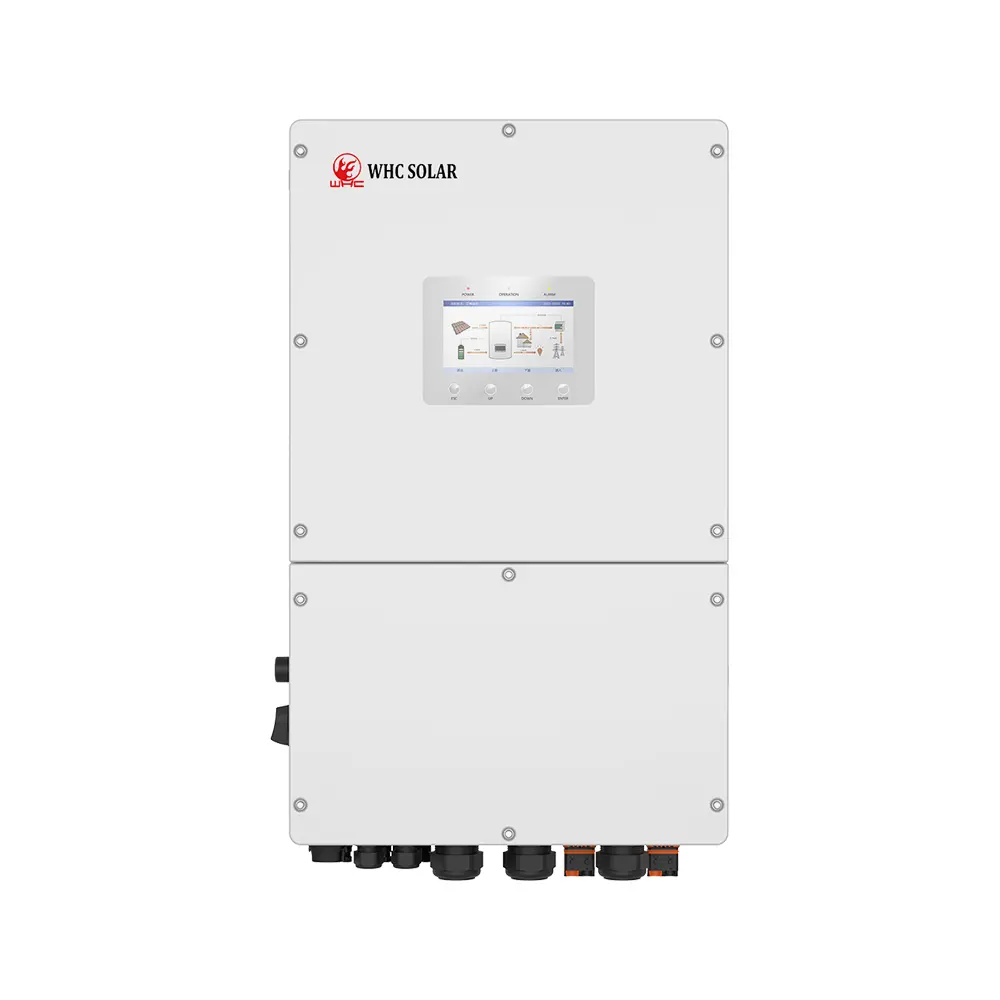
The supplier must confirm that the selected model supports the intended parallel quantity, output phase, firmware version and communication method. For larger loads, EPCs can review WHC Solar’s three-phase inverter range. Smaller modular blocks can also be evaluated within the wider solar inverter portfolio.
| Selection point | Single larger inverter | Parallel modular inverters | Procurement evidence |
|---|---|---|---|
| Initial design | Fewer power modules and simpler coordination | More communication and protection coordination | Approved single-line diagram and settings schedule |
| Expansion | May require a second power block or replacement | Can add matched units within the certified limit | Maximum parallel quantity and approved expansion procedure |
| Maintenance | A single outage can affect the full bus | A module may be isolated if the design supports it | Bypass plan, isolation method and spare-unit policy |
| Mixed batches | Not normally relevant within one unit | Firmware and hardware revisions must match | Compatibility statement using actual model and serial ranges |
Verify parallel capacity beyond the headline number
A parallel claim is useful only when the complete operating envelope is defined. Ask whether the published limit applies to single-phase, split-phase or three-phase operation. In addition, confirm how the master and follower units share current, synchronize their outputs and respond when communication is lost.
The EPC should request the approved cable lengths, communication accessories, breaker arrangement and firmware conditions. It should also ask whether all units must come from the same production batch. If a later expansion is planned, the supplier needs to explain how a new unit will be matched with the installed fleet.
For example, the current WHC product materials describe selected 5kW models that support up to nine parallel units and selected 11kW models that support up to six. Those values are model-specific, not universal. Therefore, the final design must use the datasheet and engineering confirmation for the exact inverter proposed.
Check generator charging as a controlled operating mode
Diesel support is common in remote African mini-grids, yet generator compatibility is often reduced to a simple AC-input statement. In practice, the inverter must accept the generator’s voltage and frequency range without repeated transfer or charging faults. The generator must also operate above an efficient minimum loading level.
Set a battery state-of-charge threshold for generator start, a stable warm-up period, a charging power limit and a stop threshold. Next, reserve headroom for site loads while the battery charges. If the generator supplies 60kW and the live load can reach 35kW, the charging command should not assume that all remaining nameplate power is continuously available.
The control philosophy should also define what happens when PV production rises during a generator run. Some projects reduce generator power, while others hold a minimum setpoint to avoid wet stacking. The correct sequence depends on the generator, inverter and site operating plan. It must be agreed before commissioning.
Match battery communication, charging limits and protection
The inverter and battery management system must exchange the information needed for safe charging and discharging. At minimum, verify the supported communication protocol, approved battery models, maximum current commands, alarm behavior and fallback mode. A generic statement that both products use CAN or RS485 does not prove compatibility.
Ask for a tested parameter sheet that covers charge voltage, discharge cutoff, maximum continuous current, peak current, temperature limits and state-of-charge reporting. Then compare the battery’s permitted power with the inverter bank’s demand. Adding more inverter power without enough battery current capacity can create nuisance trips and shorten usable backup time.
WHC Solar can combine the inverter with batteries, PV and protection equipment as part of a complete solar energy system. For larger business or institutional loads, the commercial solar system range provides another configuration reference.
Build serviceability into the supplier evaluation
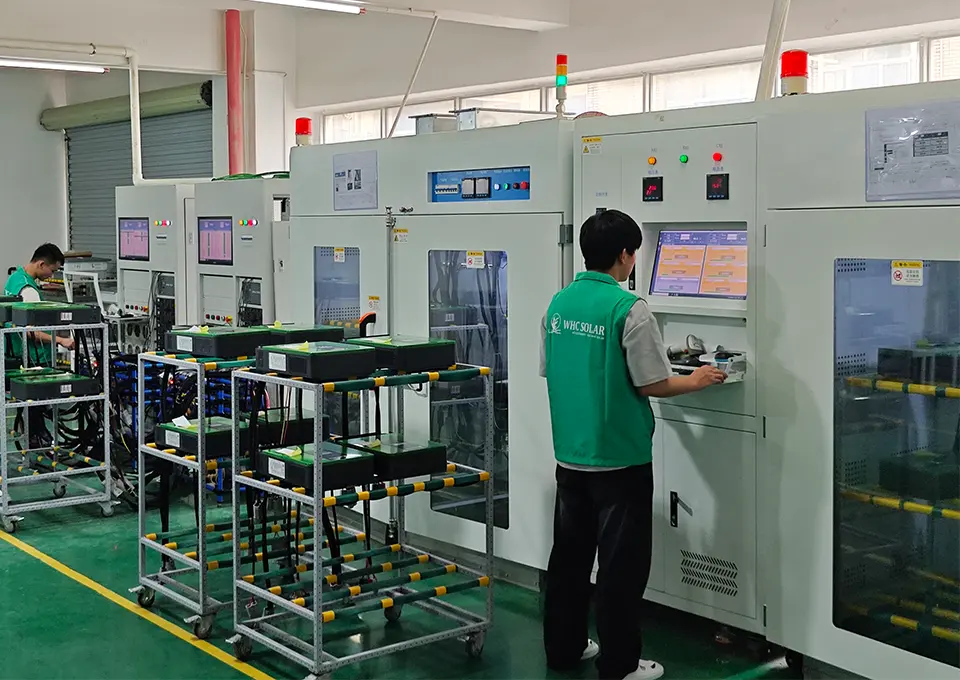
Remote sites need a maintenance plan that works without immediate factory attendance. Before purchase, request the fault-code list, commissioning checklist, settings backup method and remote diagnostic options. The EPC should know which parts can be replaced on site and which repairs require a return.
Spare planning should reflect failure impact and logistics time. Communication cables, fans, control boards, display modules and a complete spare inverter may have different priorities. Moreover, serial-number traceability and firmware records help the supplier identify the correct replacement quickly.
Factory testing also matters. Ask for the routine inspection scope, load-test evidence and the release documents supplied with each batch. A supplier that can connect product selection, testing, documentation and after-sales support reduces risk across the project life cycle.
Use three operating scenarios during design review
Community mini-grid with evening demand
Daytime PV can charge the battery and serve shops, while evening residential demand becomes the main energy event. The design should reserve inverter surge capacity for refrigerators and small motors. It should also prevent uncontrolled simultaneous reconnection after a low-battery shutdown.
Productive-use mini-grid with mills and water pumps
Here, motor starting and daytime load coordination dominate. Sequential starts, soft starters or variable-frequency drives may reduce the required inverter surge reserve. The EPC should test the worst credible combination rather than adding all nameplates without considering the operating schedule.
Clinic or school mini-grid with a standby generator
Critical circuits need defined transfer behavior and a protected minimum battery reserve. Generator start and charging logic should be tested under realistic load. The handover package must show local operators how to recognize alarms, isolate noncritical loads and request support.
Supplier documents to request before issuing the purchase order
A clear submittal package protects both the EPC and the supplier. It should include the selected inverter datasheet, approved parallel diagram, battery compatibility statement, generator input range, communications list, protection requirements and commissioning procedure.
Also request the spare-parts recommendation, firmware policy, warranty claim evidence and remote-support process. Finally, require confirmation of the exact model codes and quantities on the quotation. These checks turn an off-grid solar inverter supplier comparison into a project-risk decision instead of a price-only exercise.
The World Bank mini-grid handbook highlights the importance of technology, productive use and sustainable operating models. In addition, the World Bank’s ESMAP Global Facility on Mini Grids documents the move toward larger portfolios and stronger implementation capability. For EPC teams, that direction makes standardized hardware, records and service procedures increasingly valuable.
Frequently asked questions
How much spare inverter capacity should a mini-grid include?
There is no universal percentage. The reserve should cover credible load growth, motor starting, ambient derating and the chosen redundancy strategy. Use measured or well-supported load data, then confirm the final margin with the inverter supplier.
Can different inverter models operate in parallel?
Do not assume so. Parallel operation normally requires approved models, compatible hardware, matching firmware and a defined communication topology. Obtain written confirmation for the exact combination.
Can the generator charge batteries while supporting loads?
Yes, if the inverter architecture supports it and the generator has enough stable capacity. The charging limit must leave headroom for live loads and respect both generator and battery operating limits.
What information should an EPC send for inverter selection?
Send the load list, motor data, hourly energy profile, phase requirement, PV target, battery voltage and capacity, generator rating, site conditions and expansion plan. A single total-kilowatt figure is not enough.
Plan the mini-grid power stage with WHC Solar
WHC Solar supports EPC contractors with inverter selection, battery and PV matching, system configuration and project supply. Share your load schedule, generator data, required autonomy, phase arrangement and expansion plan through the WHC Solar contact page. The technical team can then review a suitable off-grid solar inverter configuration and the supporting equipment for your African mini-grid project.