
A grain mill can have enough battery energy for several hours of operation and still fail when its largest motor starts. It can also have a large PV array but continue burning diesel because production occurs outside the solar window. For an EPC contractor or mill owner, selecting industrial energy storage systems therefore starts with the mill’s load behavior, not with a standard battery package.
The design team must separate running power from starting demand, identify which processes can follow daytime PV, and decide which loads require backup during a grid failure. Generator operating limits, production schedules and future expansion must also enter the quotation. This guide explains the checks needed before requesting an integrated grain mill solar and storage solution.
Why Industrial Energy Storage Matters for Grain Mills
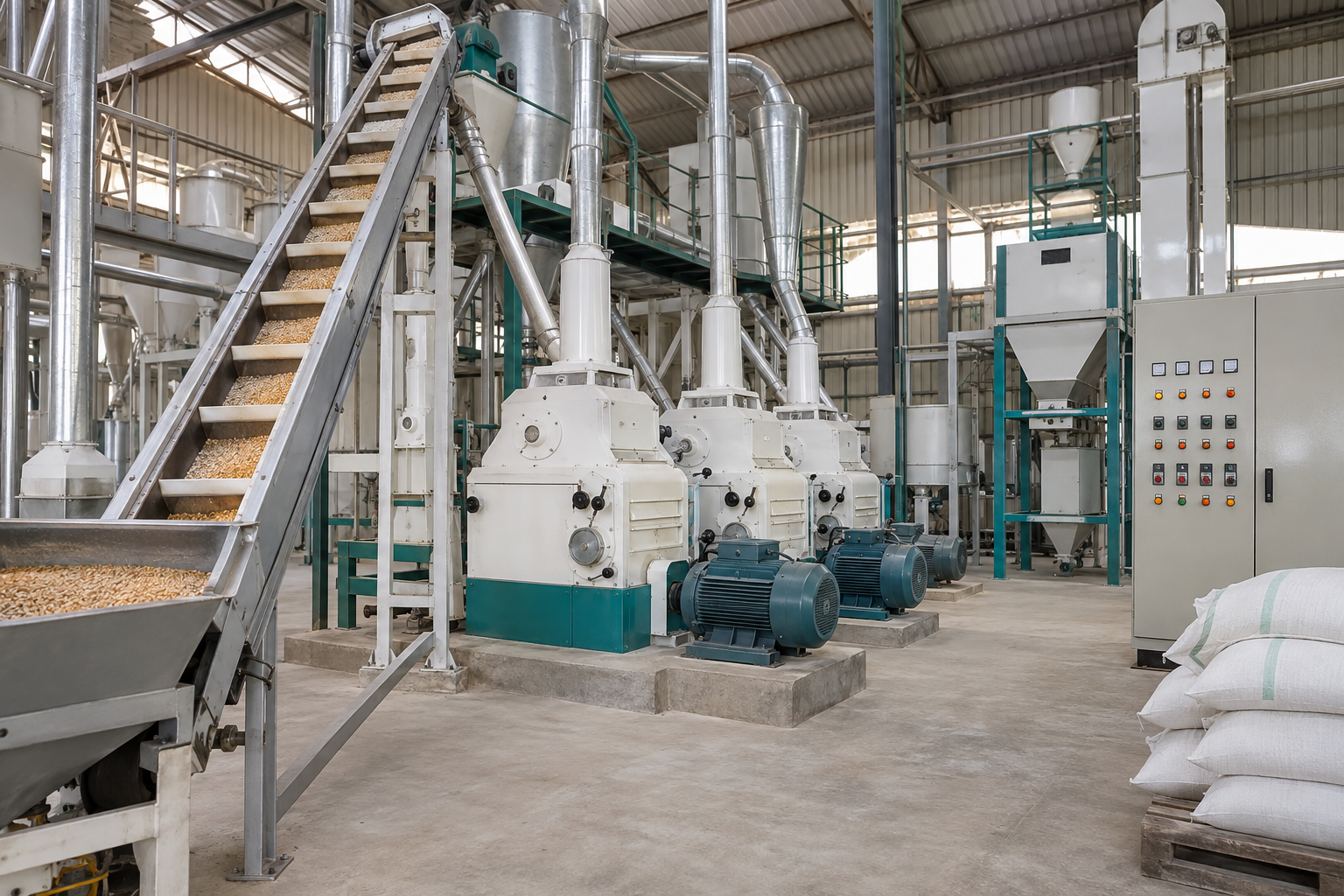
Grain processing combines productive energy use with sensitive production schedules. Milling motors, conveyors, elevators, cleaning equipment, dust extraction and packaging machines may operate together. However, their starting sequence and operating hours can differ significantly.
The IEA Africa Energy Outlook identifies growing productive energy demand in African industry and agriculture. Meanwhile, the World Bank electricity-access indicator for Sub-Saharan Africa provides regional context for markets where grid availability remains uneven. These conditions make reliability and diesel coordination important project requirements, rather than optional accessories.
Still, no single configuration suits every mill. The IRENA renewable energy market analysis for Africa emphasizes the diversity of regional energy conditions. Each grain mill must therefore be assessed with its own load profile, grid quality, solar resource and production plan.
Measure the Grain Mill Load Before Selecting Equipment
A supplier cannot size an industrial battery energy storage system reliably from the mill’s monthly electricity bill alone. The EPC team should collect a time-based load profile and an equipment schedule. Ideally, the survey should cover representative production days, startup events and periods when grid or generator power is used.
Record the Running and Starting Characteristics
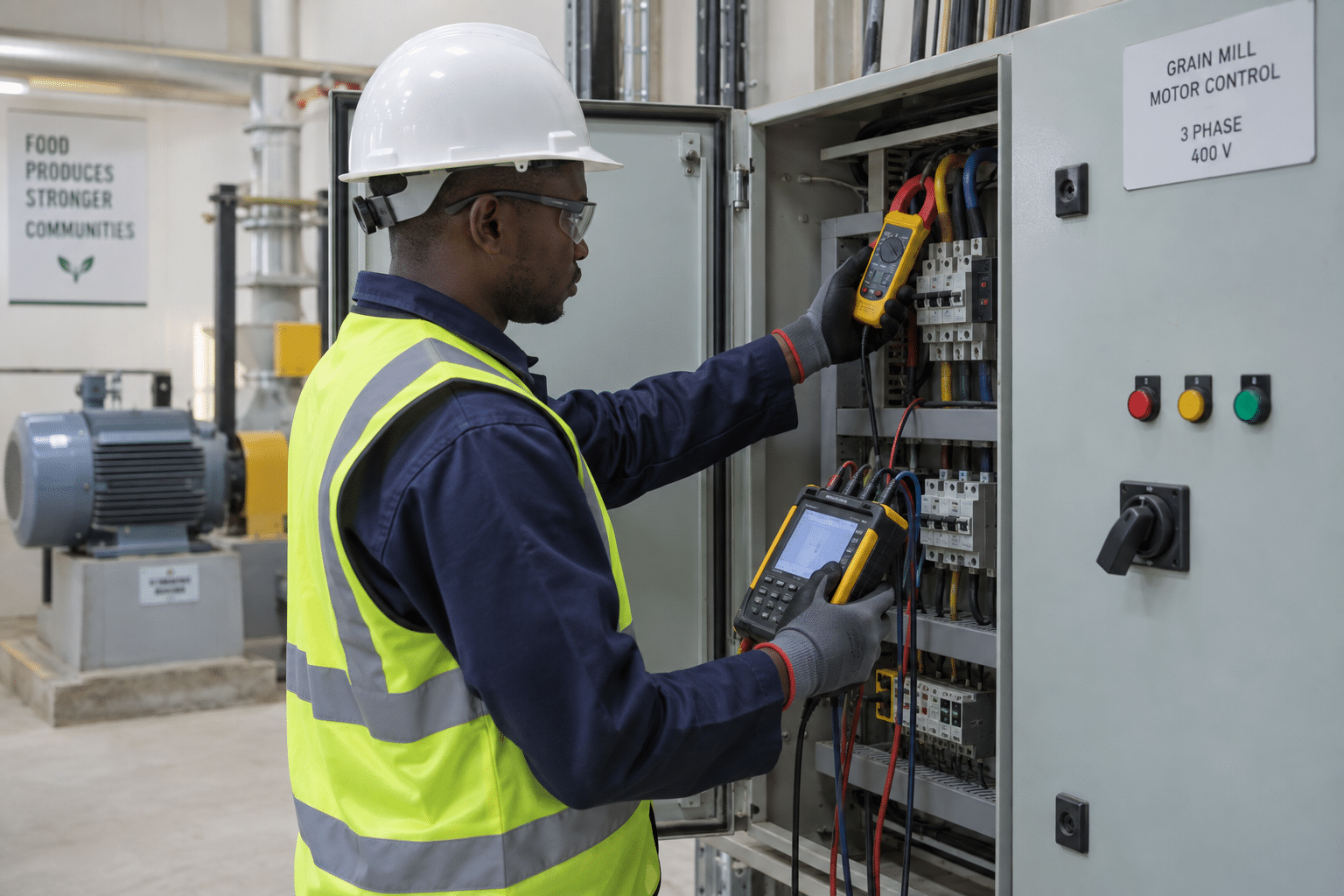
For every major motor, record the rated power, voltage, phase, power factor, rated current and starting method. The survey should show whether the motor starts directly online, through a star-delta starter, with a soft starter or through a variable-frequency drive. It should also identify which motors can start sequentially.
WHC’s preliminary configuration method checks whether the inverter or PCS can support the temporary demand created by inductive loads. A screening allowance of approximately three to five times the running power may be considered for some motor starts. However, this is not a final engineering value. The motor nameplate, starter data, manufacturer curves and actual measurements must control the design.
Separate Loads by Operational Priority
Not every machine must remain online during an outage. Divide the equipment into three groups:
- Production-critical loads: equipment needed to finish an active milling batch safely.
- Support loads: conveyors, extraction, lighting, controls and packaging equipment that support production.
- Deferrable loads: equipment that can stop or move to the daytime solar window without damaging the product.
This classification prevents the battery from being oversized for loads that can be scheduled. It also prevents an undersized system from dropping essential motors during a grid interruption.
Compare Three Solar and Storage Operating Strategies
The preferred architecture depends on whether the project prioritizes daytime fuel reduction, balanced daily operation or extended backup. The table below provides an early-stage comparison. Final equipment selection still requires measured data.
| Operating strategy | Best-fit mill condition | Primary design priority | Main procurement risk |
|---|---|---|---|
| Daytime PV-led production | Most milling can be scheduled during strong solar hours. | PV supports active loads while the battery controls short fluctuations and interruptions. | Oversizing the battery when production scheduling could achieve the same fuel reduction. |
| Balanced solar-storage operation | Production extends beyond the main solar window or the grid is unstable. | Coordinate PV, battery, grid and generator while maintaining adequate motor-starting power. | Selecting battery energy without confirming PCS power and motor transients. |
| Backup-heavy hybrid system | Long outages threaten production continuity or product handling. | Support critical loads for a defined period and coordinate generator restart. | Assuming the battery should operate the full mill during every outage. |
Size Battery Energy and PCS Power Separately
Battery energy is measured in kilowatt-hours, while the PCS or inverter must deliver power in kilowatts. A project may have sufficient kilowatt-hours but insufficient power to start a motor. Conversely, a high-power PCS does not guarantee the required backup duration.
Calculate the Required AC Energy
For each critical load, multiply its measured power by the required operating time. Then add the energy requirements:
Required AC energy = Sum of critical load kW × operating hours
For example, a measured average critical load of 60 kW operating for four hours requires 240 kWh of AC energy before battery and conversion allowances. This example illustrates the calculation only; it is not a recommended grain mill configuration.
The battery’s gross nameplate capacity should then account for the supplier-approved depth of discharge and discharge-path efficiency:
Battery nameplate energy = Required AC energy ÷ allowed DOD ÷ discharge-path efficiency
Use model-specific values from the battery, BMS and PCS documentation. Do not insert a generic DOD or efficiency value into a commercial quotation.
Check Simultaneous Running Power and Motor Starts
The PCS rating must support the highest expected combination of running loads. It must also tolerate the permitted starting sequence. Where direct starting creates an excessive transient, the project may need sequential controls, a soft starter, a variable-frequency drive or temporary generator support.
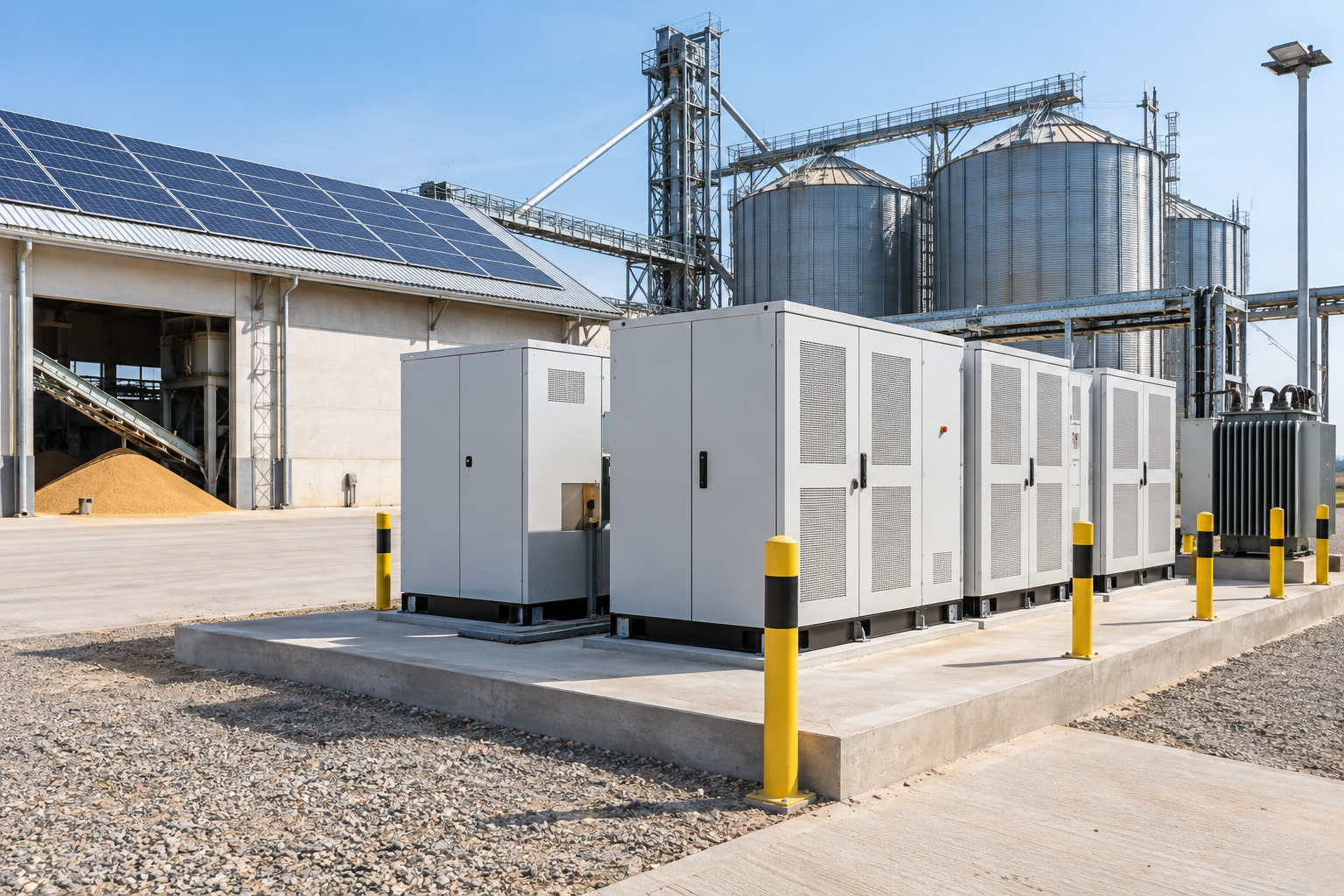
WHC Solar supplies commercial energy storage solutions that integrate battery storage, PCS and energy management functions. Reference architectures such as a 100 kW/215 kWh system can help establish procurement categories. Nevertheless, the reference rating must not replace a grain mill load study.
Use Daytime PV to Reduce Battery Cycling and Diesel Consumption
A grain mill that can shift cleaning, milling and packaging into the solar window may use PV electricity directly. This approach reduces conversion losses and avoids using the battery for energy that the PV array can deliver to an active load.
PV sizing should begin with the measured daytime load and the energy needed to recharge the battery after an outage. Designers must then apply site-specific solar-resource, temperature, orientation, shading and system-loss data. A generic peak-sun-hours assumption is not suitable for a final commercial proposal.
For broader procurement planning, WHC Solar provides commercial solar system options and integrated solar and storage project solutions. These pages help EPC teams compare solution categories before submitting the detailed load information.
Coordinate the Battery, Grid and Diesel Generator
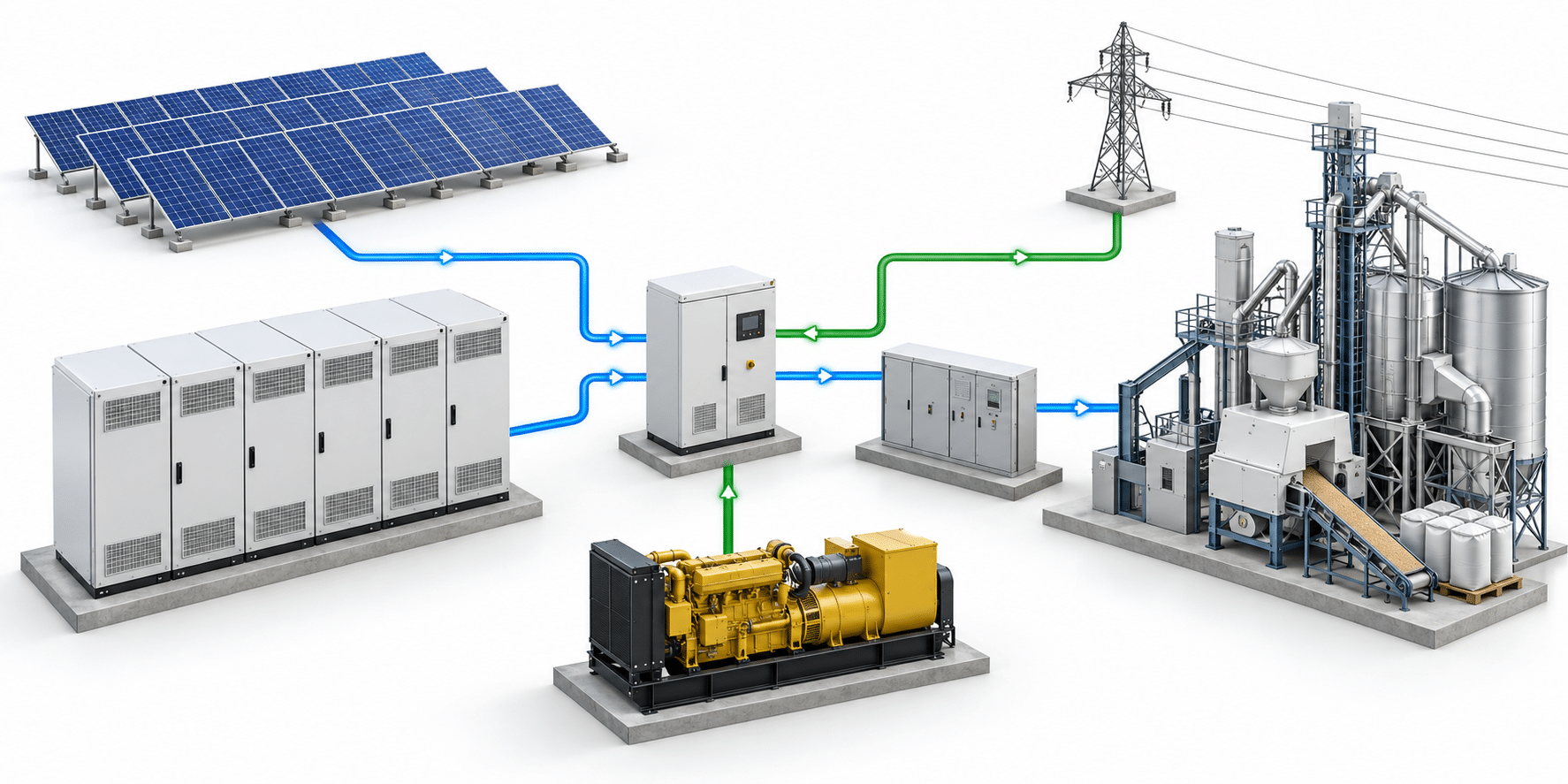
The generator should not be treated as an isolated emergency device. Its controller must coordinate with the PCS and energy management system. The control sequence should define when the generator starts, when it stops, whether it can charge the battery and which source forms the site grid during an outage.
The EPC team should also confirm generator minimum loading, voltage and frequency limits, synchronization requirements, black-start behavior and communication interfaces. Poor coordination can cause repeated generator starts, unstable source transfers or inefficient battery charging.
A practical solar-storage-diesel strategy may use PV for daytime production, the battery for short outages and load smoothing, and the generator for prolonged low-solar periods or unusually heavy production. The final priority order should reflect fuel cost, production risk and the generator manufacturer’s operating limits.
Typical African Grain Mill Scenarios
Daytime Maize Milling with an Unstable Grid
A maize mill operating mainly during daylight may prioritize direct PV consumption. The battery can bridge grid interruptions, stabilize the site and support selected loads. Motor sequencing can reduce the PCS transient requirement.
Rice Milling with Conveyors and Dust Extraction
A rice-processing line may combine milling motors with elevators, conveyors and extraction equipment. The design must evaluate which auxiliary loads must start before the main machine. Staged starting may be more important than adding battery energy.
Flour Production with Evening Packaging
A flour mill may complete heavy milling during the day but continue packaging, lighting and controls after sunset. In this case, the battery can support the smaller evening load instead of operating the complete production line overnight.
Procurement Checklist for EPC Contractors and Mill Owners
- Provide at least one representative production-day load profile.
- List every major motor, its starting method and its operating sequence.
- Define the loads that must continue during a grid failure.
- State the required backup duration and acceptable production curtailment.
- Provide grid voltage, frequency, phase and outage information.
- Provide the generator rating, controller model and communication options.
- Record ambient temperature, dust conditions and equipment-room constraints.
- Confirm whether later production-line expansion is planned.
- Request the proposed battery, BMS, PCS and EMS compatibility details.
- Require protection, commissioning and operator-training plans in the quotation.
EPC teams can also review WHC Solar’s commercial solar system cases when preparing the project brief. Case references can show possible architectures, but the grain mill’s measured data must determine the final system.
Build the Grain Mill System Around Production Risk
Effective industrial energy storage systems for grain mills balance four separate requirements: continuous running power, motor-starting capability, required backup energy and source coordination. Increasing the battery capacity alone does not solve all four.
The strongest request for quotation includes a load profile, motor list, production schedule, generator details and expansion plan. With those inputs, WHC Solar can evaluate the PV array, battery, PCS, EMS and generator interface as one integrated commercial solution.
Frequently Asked Questions
Can a Battery System Start a Grain Mill Motor Without a Generator?
It may be possible when the PCS has sufficient transient capability and the motor uses a suitable starting method. The EPC contractor must verify the motor data, starting current, starter type and PCS overload curve before approving the design.
Should the Battery Be Sized for the Entire Grain Mill?
Not always. Many projects obtain better value by backing up critical loads while scheduling high-energy production during the solar window. The correct boundary depends on the cost of downtime and the mill’s operating process.
Is Battery kWh More Important Than PCS kW?
Both are essential. Battery kWh determines operating duration. PCS kW and transient capability determine whether the system can run and start the connected machinery.
Can the Existing Diesel Generator Remain in the System?
Yes, if its electrical characteristics, controls and operating limits are compatible with the proposed hybrid architecture. The commissioning plan must test generator start, transfer, synchronization and shutdown behavior.
What Information Should a Grain Mill Send Before Requesting a Quotation?
Send the load profile, equipment and motor list, production schedule, grid information, generator details, required backup time, site conditions and future expansion plan.
Request a Grain Mill Solar and Storage Configuration
Planning a new mill, replacing excessive diesel use or adding backup to an existing production line? Send your load list to WHC Solar. Our team can review the motor-starting requirements, daytime PV opportunity, battery autonomy and generator coordination before preparing a project-specific commercial proposal.