
Two borehole pump quotations can show similar motor power and still deliver different daily water volumes. Before comparing AC vs DC solar water pumps, contractors need a common flow requirement, pumping head and operating schedule. Otherwise, a cheaper package may fail to meet the site’s water demand.
The right choice also depends on whether you are building a new system or retaining an existing pump. For African water-project buyers, the useful comparison covers the pump, motor, controller, solar array and any backup supply together.
AC vs DC solar water pumps: identify what the quotation describes
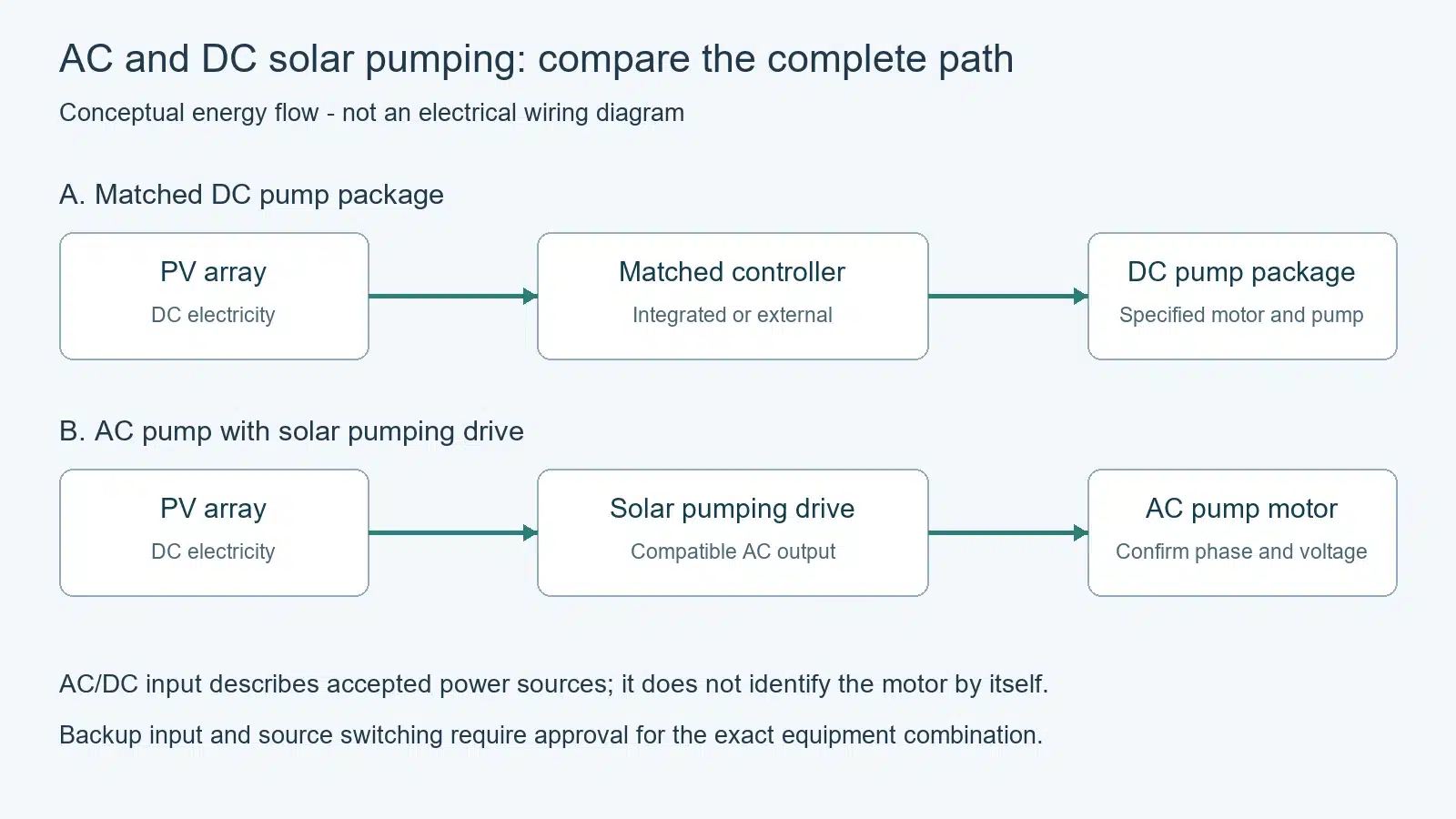
First, solar panels generate DC electricity. However, the motor and controller determine how that electricity reaches the pump. An AC pump normally requires a suitable solar pumping inverter or drive to operate from a PV array.
A DC pump package also needs the controller specified for its motor. Depending on the design, that controller may be integrated into the pump or installed separately. Do not assume that a product called a DC pump can connect directly to any solar array.
Meanwhile, “AC/DC” may describe the controller’s accepted power inputs rather than the motor type. A dual-input package can accept solar DC and a specified AC supply, but the supplier must confirm its motor, input limits and source-switching arrangement.
Compare solar water pumps on the same hydraulic duty
Start with the volume required each day and the head at which water must be delivered. Borehole depth alone is not the pumping head. The operating water level, discharge elevation, pipe losses and required delivery pressure all matter.
The USDA NRCS solar pumping design guidance explains the role of total dynamic head and system demand in pump selection. Apply those engineering principles using the conditions measured at your own site.
For example, an operating water level 35 metres below ground, an open tank inlet 8 metres above ground and estimated pipe losses of 7 metres give an illustrative total head of 50 metres. This example assumes no additional pressure requirement at delivery.
Similarly, delivering 30 cubic metres over six effective pumping hours requires an average flow of 5 cubic metres per hour. That calculation does not establish the available pumping hours or guarantee output under changing sunlight.
Therefore, ask each supplier to mark the required flow and head on the proposed pump curve. Maximum head and maximum flow are different limits; they should not be treated as one operating point.
Which pumping arrangement deserves your shortlist?
| Arrangement | When to evaluate it | Main purchasing question | Evidence to request |
|---|---|---|---|
| Matched DC pump and controller package | A new solar-led borehole installation | Can the complete package deliver the required daily water volume? | Pump curve, controller limits and site-specific production estimate |
| AC pump with a compatible solar pumping drive | An existing AC pump or a new project specifying an AC motor | Does the drive match the motor and the actual hydraulic duty? | Motor nameplate, drive approval, output limits and pump condition |
| Approved AC/DC-input pumping package | A project needing solar operation plus an AC backup source | How are power sources selected, isolated and controlled? | Input ratings, switching instructions and backup-source requirements |
The third arrangement is a power-input option, so it is not a separate motor category. Confirm the exact architecture instead of selecting by the AC/DC label alone.
Three illustrative African borehole scenarios
Ghana: a new community water-supply borehole
A contractor starting from a new borehole can evaluate a matched DC pump package against an AC pump and solar drive. Neither deserves preference until the quotations use the same water demand, operating water level and delivery conditions.
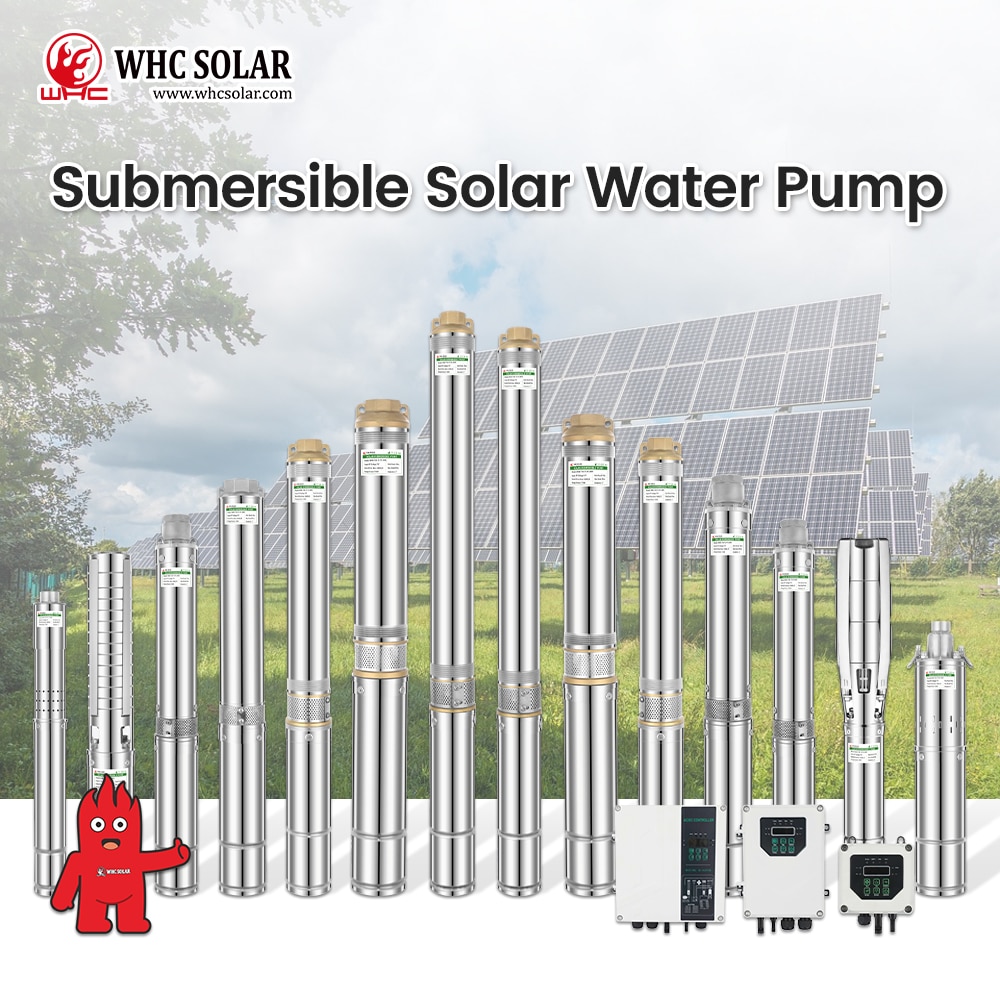
WHC Solar’s solar submersible pump range provides a starting point for product selection. In addition, request the current curve and controller specification for the exact model proposed.
Nigeria: solar conversion of an existing commercial-site pump
If the installed AC pump remains serviceable and meets demand, retaining it may avoid unnecessary replacement work. First obtain its nameplate, phase, rated voltage, current and operating history. Then check whether a proposed pumping drive is suitable.
However, solar conversion will not correct a worn pump, restricted pipework or inadequate borehole yield. Include those conditions in the comparison before deciding that reuse offers better value.
Cameroon: a school requiring an AC backup option
A school may want solar pumping during daylight and an approved AC source when additional pumping is necessary. In that case, compare dual-input packages and their switching arrangements rather than assuming any DC package can accept a generator.
Also check whether the water system can meet demand through scheduled pumping and storage. Keep that assessment separate from the question of which motor and controller combination fits the borehole.
Check the controller and PV array together
For either architecture, verify maximum PV voltage, the operating voltage window, input current and approved array power. Allow for the effect of temperature on string voltage. A generic panel-to-motor power ratio cannot replace model-specific sizing.
WHC product training covers integrated controllers, external MPPT controllers, AC/DC-input packages and drives for AC pumps. Use the solar water pump range to discuss an appropriate configuration, then obtain written confirmation of the selected combination.
Next, compare dry-run protection, tank-level control, restart behavior and fault indication. Include cable lengths and service access because these affect installation and fault recovery.
Compare the complete supply scope
A pump-only price is not comparable with an installed pumping package. Check whether each quotation includes the controller or drive, PV array, mounting, cables, protections, sensors, delivery pipework and installation support.
The FAO-hosted solar pumping practice brief describes pumping as a coordinated system of components. It also highlights groundwater management. More available solar energy does not mean the borehole can sustainably supply more water.
Review WHC Solar water-pump project references for application context. A previous installation illustrates experience, but its configuration should not be copied without checking your site.
Frequently asked questions
Are DC solar water pumps always more efficient?
No universal ranking applies. Compare complete-system performance at the required flow, head and operating conditions, using evidence for the proposed models.
Can an existing AC borehole pump run on solar?
Potentially, through a compatible solar pumping drive. Confirm the motor requirements, pump condition, hydraulic duty and PV configuration before ordering.
Does AC/DC mean the pump accepts any power source?
No. The label may describe controller inputs. Verify allowed voltage, phase, frequency and switching arrangements, including any generator requirements.
Does maximum head show the depth at which rated flow is available?
No. Select from the pump curve at the required flow and total dynamic head. Borehole depth alone is insufficient.
What should a borehole contractor send for a quotation?
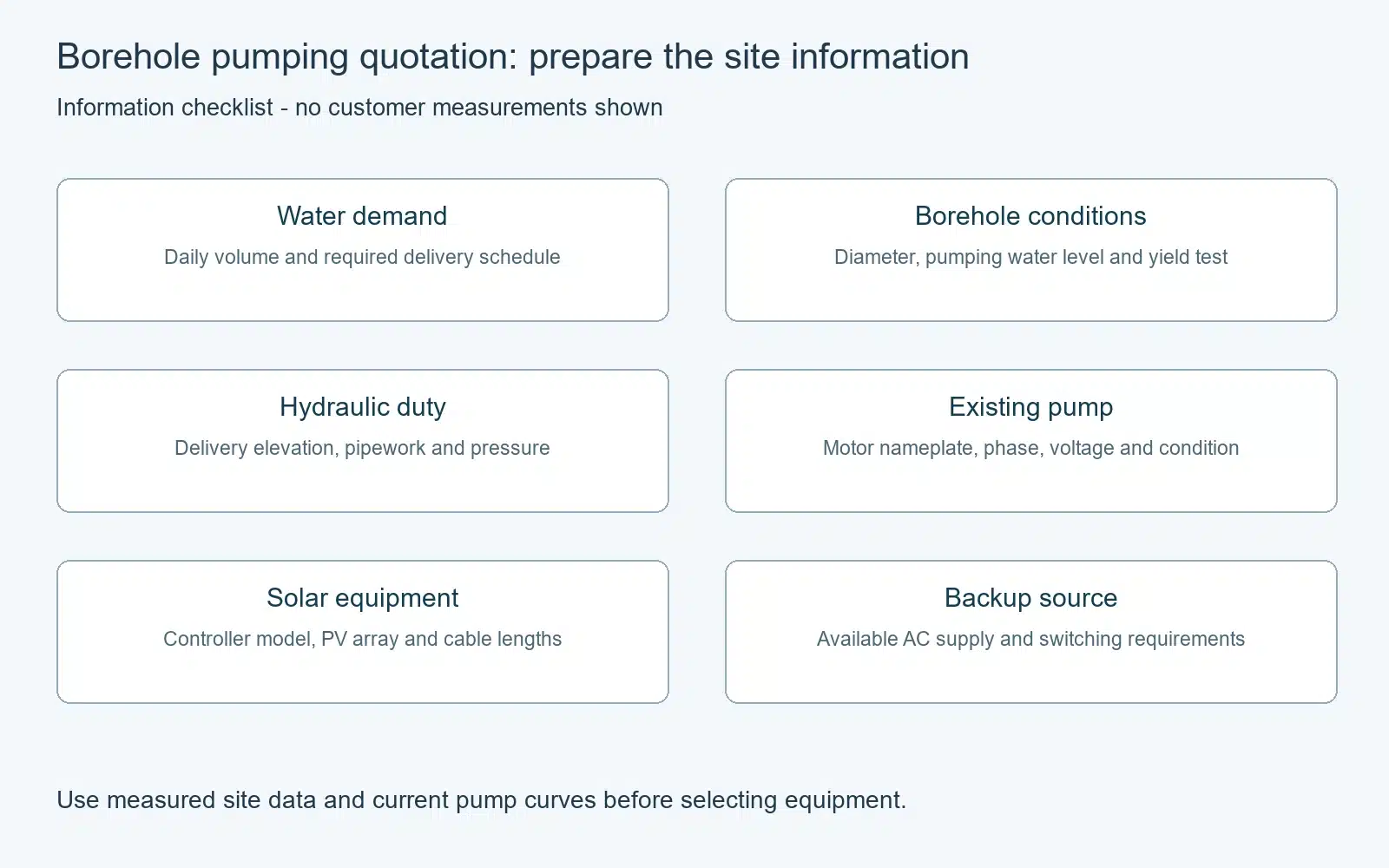
Provide daily demand, borehole diameter, pumping water level, yield-test information, discharge elevation, pipe details, site location and available power sources. Include the existing motor nameplate for a retrofit.
Request a matched borehole pumping proposal
AC vs DC solar water pumps should be compared against the same water-delivery requirement. Choose the arrangement that meets that duty with a supported controller, suitable power inputs and a clear installation scope.
Contact WHC Solar for a borehole pumping configuration and B2B quotation. Send your hydraulic data, existing equipment details and backup-power requirements so the proposal can address the complete system.