
African construction camps rarely maintain one stable load from mobilization to handover. Site offices and security lighting may dominate first. Accommodation, workshops, pumps and refrigeration may arrive later. Sizing only for the initial load can create long generator hours or an unplanned battery upgrade.
A hybrid solar system for Africa must therefore be planned around changing load stages, critical equipment and the camp’s relocation schedule. EPC contractors should evaluate the PV array, battery bank, hybrid inverter, generator interface, protection system and expansion method as one coordinated solution.
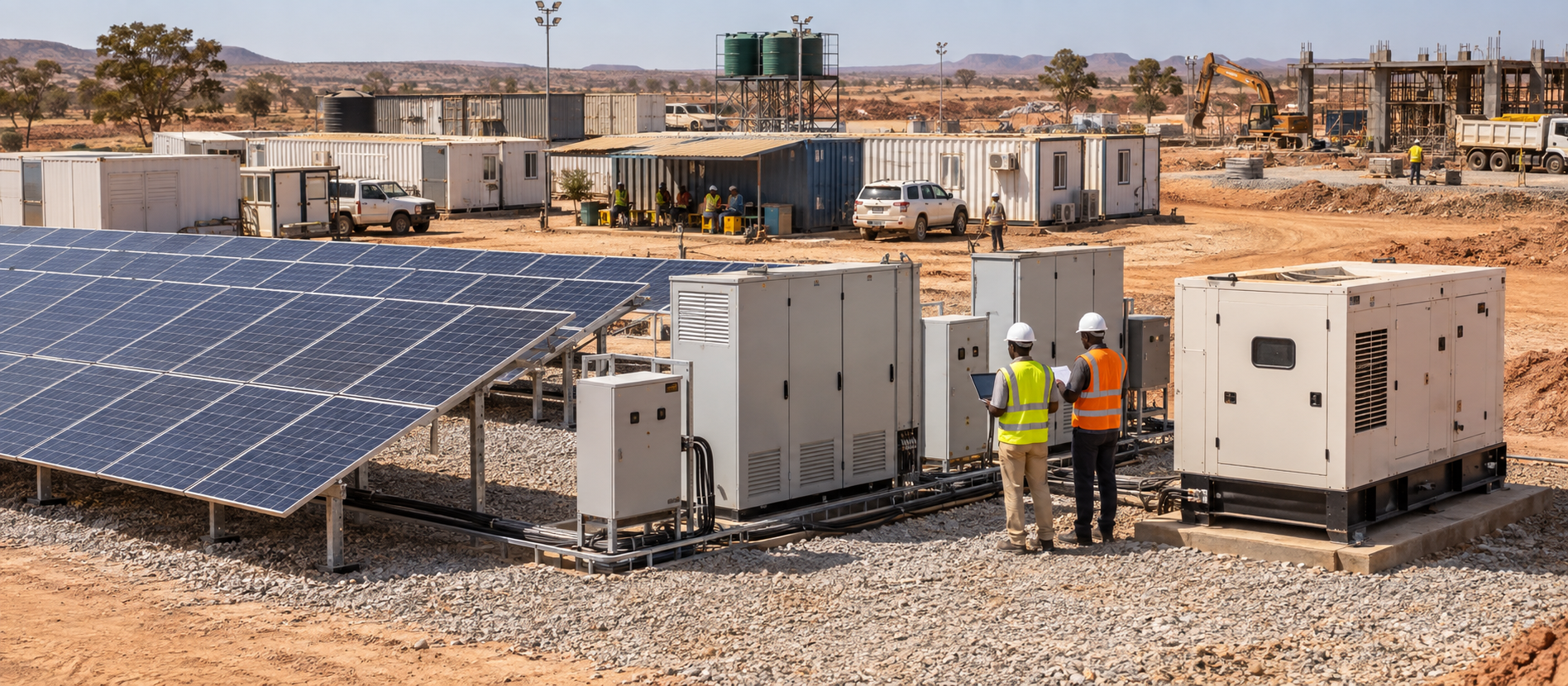
Why Construction Camps Need a Different Hybrid Solar System Plan
Weak grids, dust, high temperatures and limited technical support also affect equipment selection. Therefore, the quotation should start with a phase-by-phase load schedule rather than one total-kilowatt figure.
| Camp phase | Typical loads | Main sizing concern | Expansion decision |
|---|---|---|---|
| Mobilization | Security lights, communications, site office and basic accommodation | Reliable overnight supply with low initial demand | Install the core inverter, controls and protected distribution platform |
| Main construction | Workshops, power tools, pumps, cooling, kitchens and larger accommodation blocks | Motor starting current, daytime energy and rapid load growth | Add PV, battery modules or parallel power-conversion capacity where supported |
| Finishing and commissioning | Testing equipment, temporary offices, lighting and reduced workshop demand | Avoid operating an oversized generator at an unsuitable loading level | Reconfigure operating priorities and prepare reusable modules for relocation |
Step 1: Build a Load Schedule Before Sizing the Battery
Record every load by rated power, quantity, operating hours, phase and starting behavior. Then separate the schedule into critical, deferrable and intermittent loads.
Critical loads may include communications, security, refrigeration and essential lighting. Large motors, compressors and pumps need a separate starting-current review. Do not size the inverter from daily kilowatt-hours alone. It must cover simultaneous load, permitted overload, motor starting and phase balance.
Contractors can compare integrated configurations on the WHC Solar commercial and industrial solar systems page and review broader commercial solar solution options before requesting a project-specific design.
Step 2: Calculate Battery Autonomy from Critical Energy
Battery autonomy should cover the energy required during cloudy periods, generator restrictions or nighttime operation:
Critical energy demand (kWh) = average critical load (kW) × required autonomy (hours)
The nominal battery capacity must then allow for the permitted depth of discharge, discharge-path efficiency, temperature conditions and the supplier’s reserve policy:
Indicative nominal battery capacity = critical energy demand ÷ (usable DOD × discharge-path efficiency)
For example, a 25 kW critical average load operating for 10 hours requires 250 kWh. Illustrative assumptions of 80% usable depth of discharge and 92% discharge-path efficiency produce about 340 kWh of nominal storage. Replace these assumptions with the selected battery, BMS, inverter and site-temperature data.
Also specify charge and discharge power. Sufficient kilowatt-hours do not guarantee the required kilowatts if the BMS current limit, C-rate or inverter interface is unsuitable.
Step 3: Size PV from the Site Resource and Daily Energy Balance
PV capacity should reflect the camp’s daily energy demand, local solar resource, module orientation, temperature losses, dust, cable losses and power-conversion efficiency. A preliminary formula is:
Indicative PV capacity (kWp) = daily solar-supplied energy ÷ (peak-sun hours × performance factor)
A single solar-hours assumption should not be applied to every African country or season. EPC teams can use the World Bank’s solar photovoltaic potential resources for early-stage assessment, followed by site-specific engineering data.
Step 4: Coordinate the Generator with the Hybrid Solar System
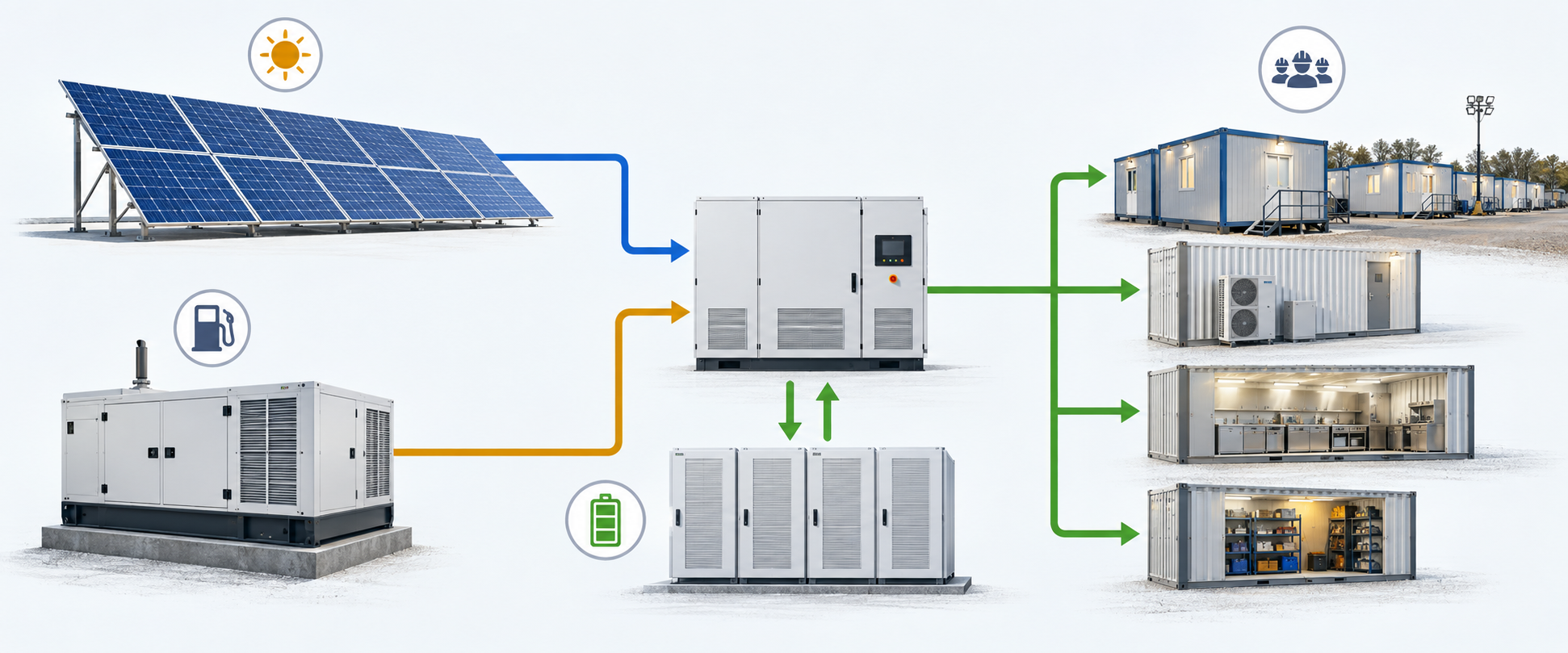
In a solar diesel hybrid system, the control strategy must define when the generator starts, which loads it serves, whether it charges the battery and when it stops.
Confirm generator voltage, frequency, phase sequence, rated power, loading range, automatic-start interface and step-load response. Verify minimum loading and warm-up or cool-down requirements from the generator manual.
Typical logic prioritizes PV for daytime loads, uses excess solar to charge the battery and starts the generator when state of charge or load reaches an approved threshold.
However, the start and stop thresholds require hysteresis and minimum-run rules. Otherwise, fluctuating loads or short cloud events may cause frequent generator cycling. The control design must also prevent unintended backfeed and coordinate all transfer devices, breakers, earthing arrangements and emergency-stop circuits.
The IRENA guide to hybrid mini-grids and isolated grids provides additional context on load assessment, renewable generation, storage and diesel integration.
Step 5: Plan Modular Expansion Before Ordering Equipment
A modular solar power system is not created simply by leaving empty floor space. The original design must confirm how additional PV strings, batteries and inverter capacity will be connected and controlled.
Confirm maximum PV input, MPPT arrangement, battery voltage range, BMS protocol, permitted inverter parallel quantity and firmware. Adding new modules to an aged battery bank requires a state-of-health and compatibility review.
Reserve approved expansion capacity in the distribution board, busbars, protection, ventilation and communications. For movable camps, modular skids or cabinets can simplify disconnection and asset reuse.
Available WHC Solar inverter configurations should be matched to the final load schedule and current technical datasheet rather than selected only by the headline power rating.
Configuration Comparison for EPC Procurement
The following comparison helps contractors select the right architecture for the construction program rather than choosing only by initial purchase price.
| Option | Best fit | Procurement advantage | Main risk to check |
|---|---|---|---|
| Fixed solar and battery package | Small camp with stable, well-documented loads | Simpler initial bill of materials | Limited flexibility when workforce or workshop demand grows |
| Modular hybrid solar system | Multi-phase project with uncertain future demand | Supports planned PV, storage or inverter expansion | Expansion limits and communication compatibility must be documented in advance |
| Generator-led hybrid system | High motor loads or restricted PV installation area | Uses the existing generator for peaks and extended low-solar periods | Poor control settings can increase fuel use and generator cycling |
Typical African Construction Camp Scenarios
Road and Bridge Contractor Camp
Security lighting, communications and accommodation create a continuous base load, while workshops and water pumps add intermittent peaks. The design should separate nighttime critical energy from daytime tool demand and reserve expansion capacity for later work fronts.
Remote Mine Development Camp
Staff accommodation, refrigeration, communications and maintenance equipment may operate far from a reliable grid. The generator can support high-load periods, while PV and batteries reduce unnecessary generator operation during lower-load hours. Fuel-delivery risk should be included in the autonomy decision.
Temporary Public-Infrastructure Project
A school, clinic or utility construction program may need a movable site office and worker camp before permanent power is available. A modular system can later be relocated or reassigned, provided transport frames, reconnection procedures and recommissioning requirements are planned from the start.
Supplier Documentation Checklist
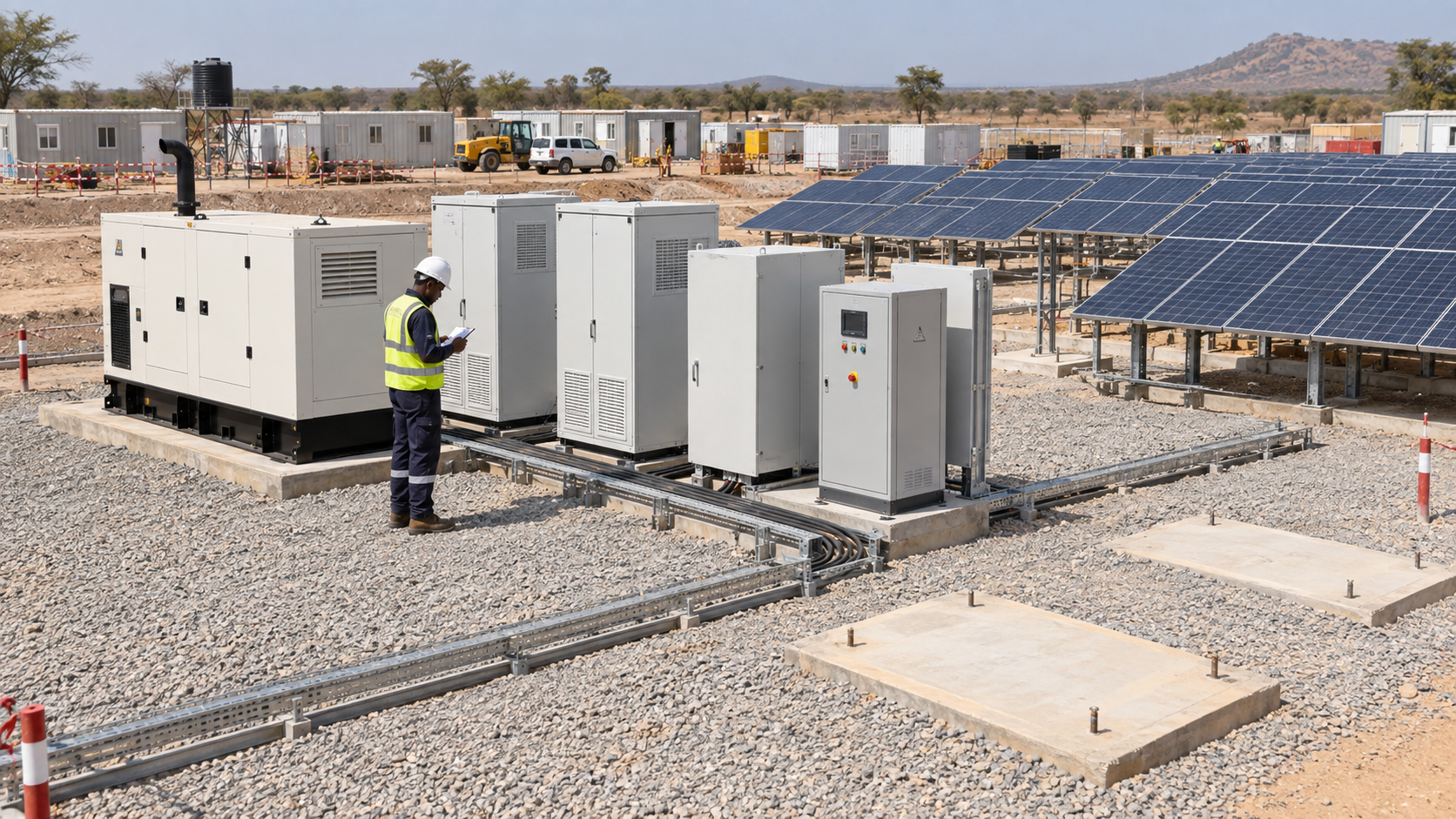
Before placing an order, request a single coordinated technical package covering the PV array, battery, BMS, inverter or PCS, generator interface, protection and monitoring system. The package should include:
- A phase-by-phase load and energy calculation.
- Critical-load autonomy and battery derating assumptions.
- Motor-starting and inverter overload checks.
- Battery voltage, BMS protocol and inverter compatibility confirmation.
- Generator start, stop, charging and transfer logic.
- Protection, earthing, cable and distribution requirements.
- Expansion limits for PV, battery and inverter capacity.
- Commissioning tests, operator training and relocation requirements.
The World Bank Battery Storage Program also highlights the role of storage in integrating renewable power and improving system reliability.
Conclusion: Specify the Camp Before Selecting the System
A reliable hybrid solar system for Africa begins with the construction schedule, not a standard equipment bundle. EPC contractors should document critical loads, operating hours, motor starts, generator characteristics, solar resource, autonomy targets and future camp phases before confirming capacity.
The selected configuration should also be practical to transport, commission, maintain and reuse after the current project ends.
Frequently Asked Questions
How many battery hours should a construction camp specify?
There is no universal value. Calculate autonomy from critical nighttime loads, expected low-solar periods, generator availability, fuel-delivery risk and the approved battery depth of discharge.
Can an existing diesel generator be connected to a hybrid inverter?
Potentially, but compatibility must be checked. Confirm voltage, frequency, phase configuration, automatic-start interface, loading limits, transfer method and the inverter’s generator-input requirements.
Should battery capacity be based on the camp’s peak load?
No. Battery energy is mainly based on kilowatt-hours and autonomy, while battery discharge power, inverter capacity and surge capability must support the required kilowatts.
Can the battery bank be expanded after one year?
Only if the battery manufacturer permits it and the BMS, voltage, module condition and system design remain compatible. Mixing new modules with an aged bank requires technical review.
What information should an EPC send for a quotation?
Provide the load list, operating hours, motor data, phase configuration, site location, autonomy target, generator specification, available installation area, project schedule and expected expansion stages.
Request a Construction Camp Solar System Review
WHC Solar supports integrated solar system configuration for EPC and project contractors. Send your construction-camp load schedule, generator datasheet, site location, required backup hours and expansion plan through the WHC Solar contact page for a project-specific configuration and quotation review.