
Choosing the right solar street light supplier is a project decision, not simply a lamp purchasing decision. For EPC contractors, distributors, and project developers in Africa, an incorrect specification can lead to weak illumination, incomplete battery charging, excessive maintenance, delayed handover, and warranty disputes.
In our discussions with African project and wholesale buyers, we normally begin with the road, operating schedule, weather conditions, and installation plan. Only then do we compare the solar panel, LiFePO4 battery, LED source, controller, pole, mounting structure, and foundation. Buyers can review the WHC Solar solar lighting product range before preparing a project request.
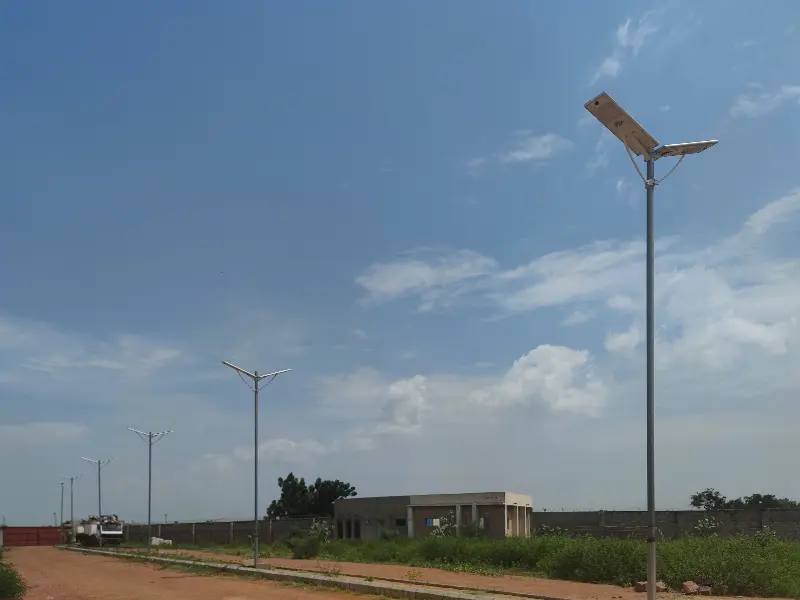
Why African Projects Need a Project-Based Solar Street Light Supplier
Off-grid lighting is relevant in communities where grid extension is slow, expensive, or unreliable. According to the World Bank Off-Grid Solar Market Trends findings, off-grid solar supplied 55% of new electricity connections in Sub-Saharan Africa between 2020 and 2022.
Meanwhile, the IRENA and African Development Bank renewable energy analysis identifies renewable energy as an important part of Africa’s energy-access and development pathway. For a street lighting project, however, the commercial value appears only when the system provides the required illumination throughout the agreed operating period.
Therefore, a qualified supplier should calculate the system instead of quoting only a wattage printed on a lamp housing. The supplier must also understand delivery deadlines, installation conditions, spare-parts planning, and the documentation required by an EPC or municipal buyer.
Prepare the Project Brief Before Requesting a Quotation
A useful quotation starts with a complete project brief. Otherwise, two suppliers may quote products called “100W solar street lights” while offering completely different solar panels, batteries, LED output, structures, and operating schedules.
1. Define the Road and Lighting Requirement
First, provide the road width, road type, pole height, pole spacing, installation arrangement, and required brightness. A village access road, school compound, municipal avenue, and industrial yard do not require the same optical distribution.
2. Confirm the Night Operating Schedule
Next, specify whether the light must operate at full brightness all night or use a programmed dimming schedule. For example, a controller may run the lamp at higher output during busy evening hours and reduce output after midnight. As a result, the project can balance brightness with battery autonomy.
3. State the Required Rainy-Day Autonomy
In addition, tell the supplier how many consecutive low-sunlight days the system should support. Battery capacity and solar panel size must increase when a project requires longer autonomy. The final configuration should also reflect local solar conditions, seasonal weather, shading, and system losses.
4. Provide Site and Delivery Information
Finally, include the installation country, coastal or inland environment, approximate wind conditions, project quantity, required delivery date, and whether poles, brackets, anchor cages, and foundation drawings are needed. This information helps the supplier evaluate corrosion protection, packaging, container loading, and installation support.
All-in-One vs Split Solar Street Lights for B2B Projects
An all in one solar street light supplier can offer compact products that integrate the panel, battery, LED, and controller. By contrast, a split solar street light separates major components and allows more flexible panel and battery sizing. The correct choice depends on installation speed, project scale, maintenance strategy, and performance requirements.
| Product Type | Best-Fit Project | Buyer Should Verify | Main Procurement Risk |
|---|---|---|---|
| All-in-one | Community roads, schools, compounds, pathways, and projects requiring fast installation | Actual panel power, battery energy, LED output, thermal design, controller mode, and mounting height | Selecting a compact housing without enough charging or storage capacity |
| Split system | Municipal roads, highways, larger public areas, and projects requiring flexible configuration | Panel orientation, cable size, battery enclosure, pole structure, wiring, and installation workmanship | Higher installation complexity and inconsistent on-site assembly |
| Project-grade series | Government tenders, EPC contracts, and projects with defined autonomy and lighting requirements | Photometric file, technical datasheet, rainy-day target, warranty scope, sample approval, and delivery plan | Approving a quotation before technical specifications are fixed |
| Wholesale series | Distributors requiring repeatable models, marketable pricing, and manageable stock | MOQ, model continuity, packaging, spare parts, local demand, and reorder lead time | Buying too many similar models or selecting price without considering returns |
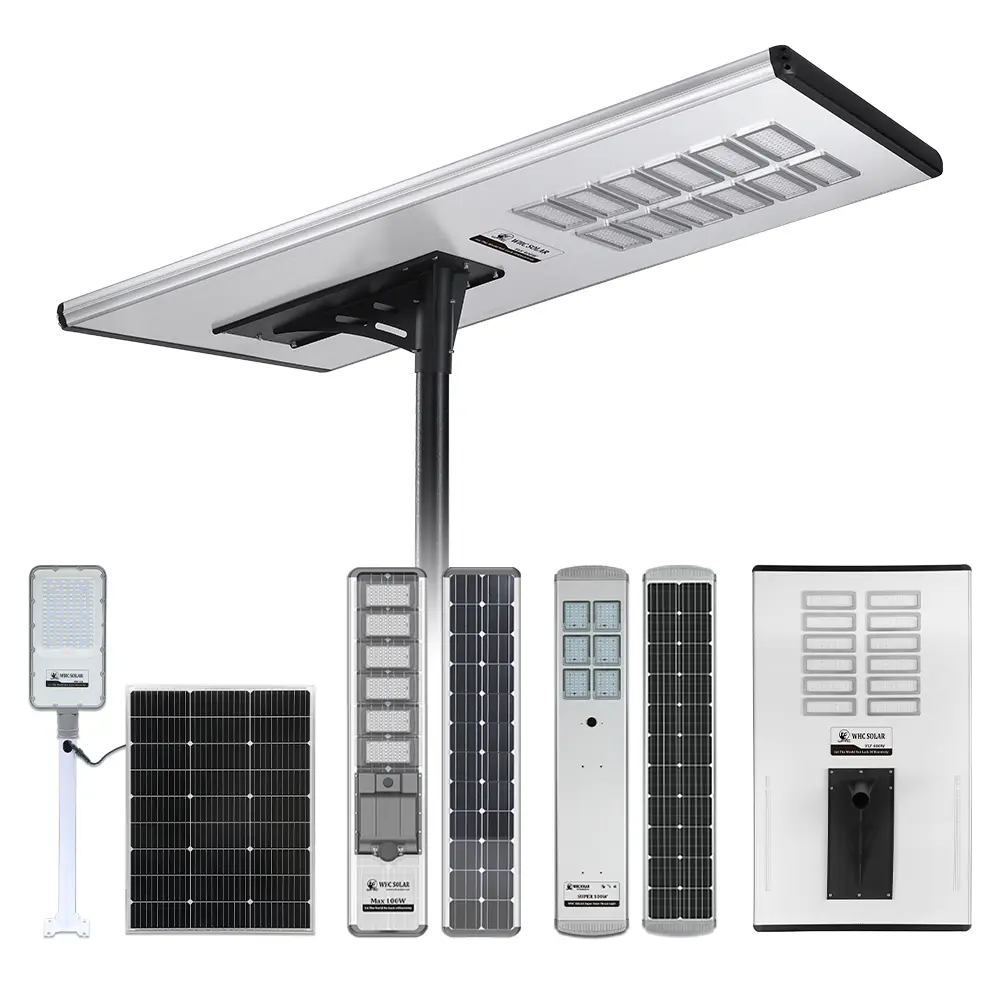
WHC Solar’s project materials position the FLY series for project demand, with a 40W-400W selection range and configurations designed around longer rainy-day support. Meanwhile, COBRA and PSL options address wholesale buyers who prioritize marketable models, stock turnover, and installation convenience. PB models provide another option for buyers balancing project specifications with repeat sales.
Nevertheless, series names alone are not sufficient for procurement. Buyers should request the current datasheet because LED source, battery capacity, solar panel size, warranty, and autonomy can vary by model and configuration. WHC Solar’s solar lighting solutions page provides an overview of available system structures and application options.
How to Check Whether a Solar Street Light Specification Is Realistic
A common sourcing mistake is comparing only the advertised LED wattage. In practice, the solar panel determines how much energy the system can generate, while the battery determines how much usable energy it can store. Therefore, the three values must be checked together.
Step 1: Estimate Daily Solar Generation
Use this initial screening formula: daily PV energy = solar panel power × effective peak-sun hours. For example, a 140W solar panel with five effective sun hours produces a theoretical 700Wh per day before charging, temperature, dust, wiring, and controller losses.
Step 2: Check the Battery Charging Requirement
If the quoted battery stores 960Wh, dividing 960Wh by 140W gives approximately 6.86 hours under ideal rated output. Because real systems have losses, the actual charging time will be longer. Consequently, a supplier should explain whether the battery starts each day partly charged, whether the lamp uses dimming, and how the design performs during consecutive cloudy days.
Step 3: Calculate the Night Load
Next, estimate night energy demand = actual LED power × operating hours × dimming factor. An advertised 120W model does not always operate at a continuous electrical input of 120W. For that reason, buyers should request the actual LED input, controller schedule, and photometric performance instead of relying on the model name.
Step 4: Add Engineering Margins
Finally, account for battery depth of discharge, conversion losses, high temperature, panel dust, ageing, and seasonal sunlight. This calculation does not replace a lighting design. However, it quickly exposes quotations that lack enough information for technical approval.
Solar Street Light Supplier Evaluation Priority Ranking
For EPC and municipal procurement, we recommend ranking suppliers by project risk reduction rather than unit price alone. The following order reflects the problems that most directly affect commissioning, acceptance, and long-term maintenance.
| Priority | Evaluation Point | Evidence to Request | Why It Matters |
|---|---|---|---|
| 1 | Configuration accuracy | Energy calculation, lighting layout, operating mode, and autonomy assumptions | Reduces underperformance and acceptance risk |
| 2 | Component transparency | Panel wattage, battery Wh/Ah, cell grade, LED source, controller, materials, and IP rating | Prevents misleading model names and hidden downgrades |
| 3 | Relevant project references | Country, quantity, model, wattage, installation images, and operating conditions | Shows whether the supplier has supported comparable projects |
| 4 | Quality control | Inspection records, production photos, sample testing, packing standard, and traceability | Improves batch consistency for large orders |
| 5 | Delivery and after-sales plan | Lead time, spare-parts ratio, warranty process, manuals, and technical response procedure | Protects the EPC schedule and reduces maintenance delays |
| 6 | Commercial support | MOQ, model continuity, distributor terms, container plan, and marketing materials | Supports repeat orders and healthier inventory turnover |

Real WHC Solar Street Lighting Project References
Project references help buyers compare product structure, quantity, and application environment. However, an existing case should be treated as evidence of delivery experience rather than a configuration that can be copied without site analysis.
Burkina Faso: 50 Sets of 60W All-in-One Street Lights
WHC Solar records a 60W all-in-one solar street light project in Burkina Faso using 50 Rising-series units. This case is relevant to EPC buyers comparing compact products for faster installation.
Sierra Leone: 100 Sets of 30W All-in-One Street Lights
Another reference covers 100 sets of 30W solar street lights in Sierra Leone. For distributors and contractors, the case demonstrates a repeatable model used at a larger project quantity.
Mali: 80W Road Lighting Application
The WHC solar street lighting project in Mali uses an 80W unit with an integrated LiFePO4 battery and automatic day/night control. Its project page reports operating time of up to 72 hours for the installed configuration.
Even so, buyers should not select 30W, 60W, or 80W solely from these references. Pole height, road width, lighting target, autonomy, and local sunlight must still be reviewed for each new project.
Common Procurement Mistakes
Buying by nominal wattage: A large printed wattage does not confirm brightness or runtime. Instead, compare actual LED input, lumens, optical distribution, panel power, and battery energy.
Ignoring the control schedule: Two identical-looking lamps can have different operating results because one uses intelligent dimming. Therefore, request the hourly lighting mode before approval.
Comparing price before fixing specifications: A lower quotation may exclude poles, anchor cages, cables, spare parts, or stronger packaging. As a result, the lowest unit price may not produce the lowest delivered project cost.
Skipping sample and pre-shipment checks: Samples, datasheets, packing details, and batch inspection records should be approved before mass production. In addition, EPC buyers should define how replacement components will be supplied.
Using one design for every location: Coastal corrosion, high ambient temperature, dust, shading, road geometry, and seasonal rainfall can change the correct specification. Consequently, project inputs must be reviewed before the final model is confirmed.
How WHC Solar Supports EPC Contractors and Distributors
As a full solar energy solution provider, WHC Solar supports both project-oriented and wholesale solar lighting requirements. For EPC buyers, the process can include project-input review, product selection, configuration discussion, sample confirmation, packaging planning, and technical documentation.
For distributors, the product strategy can focus on a smaller group of repeatable models, practical MOQ, market positioning, spare parts, and reorder support. Meanwhile, project buyers can evaluate FLY or other project-oriented configurations according to road conditions and autonomy targets. Wholesale customers can compare COBRA, PB, PSL, and other available models according to local price levels and customer demand.
Ultimately, the recommended configuration must be confirmed against the current datasheet, order quantity, project location, and contract requirements.
Conclusion
A reliable solar street light supplier should do more than send a catalog and unit price. The supplier should help buyers verify the lighting requirement, solar generation, battery capacity, control schedule, installation structure, quality evidence, delivery plan, and after-sales process.
Therefore, African EPC contractors and distributors should compare suppliers through calculations, project references, samples, and documentation. This approach reduces technical disputes and makes the final quotation easier to evaluate commercially.
FAQ
What information should I send to a solar street light supplier?
Provide the road width, pole height, pole spacing, required brightness, nightly operating hours, rainy-day target, project country, installation environment, quantity, and delivery deadline. In addition, state whether the quotation should include poles, anchor cages, brackets, cables, and spare parts.
Are all-in-one solar street lights suitable for municipal projects?
Yes, they can suit municipal roads, schools, compounds, and community projects when the integrated panel, battery, LED, and controller meet the technical requirement. However, larger or more demanding roads may benefit from a split design with greater configuration flexibility.
How can buyers identify overstated solar street light specifications?
Start by comparing solar panel power, effective sun hours, battery energy, actual LED input, operating time, and dimming mode. If the daily solar generation cannot reasonably replace the nightly energy consumption, ask the supplier for a detailed calculation and test data.
Which WHC Solar series is suitable for EPC projects?
FLY and other project-oriented models can be evaluated for EPC requirements, while COBRA, PB, and PSL options address different wholesale and project priorities. Nevertheless, WHC Solar should confirm the final series after reviewing the site and tender specifications.
Should an EPC contractor order a sample before mass production?
Yes. A sample allows the buyer to check construction, brightness, controller mode, installation method, labels, packaging, and documentation. After approval, the sample standard can also support pre-shipment batch inspection.
CTA
Looking for a solar street light supplier for an African road, school, municipal, commercial, or community lighting project? Send WHC Solar your project location, road dimensions, pole height, operating schedule, required autonomy, quantity, and delivery deadline.
Request a Solar Street Light Project Configuration and B2B Quotation