
For African fish farms, aquaculture ponds and rural water circulation projects, choosing the right solar water pump supplier is not only a product sourcing decision. As a result, it affects pond water movement, daily water transfer, oxygen support, fish survival risk, maintenance work and long-term project cost.
In West Africa, Central Africa and Sub-Saharan Africa, many aquaculture sites are located in areas with weak grid access, unstable voltage or high diesel fuel cost. For this reason, a solar water pump system can help fish farm owners, distributors and installers reduce dependence on grid power or small fuel pumps. However, the pump must be selected according to flow rate, head, water source, controller protection and local service conditions.
In addition, aquaculture has a different pumping logic from ordinary crop irrigation. For example, fish ponds may need water circulation, pond filling, pond drainage, water exchange, water transfer between ponds and support for simple inlet oxygenation. Meanwhile, the FAO aquaculture aeration and oxygenation resource explains that dissolved oxygen is a critical water quality factor in fish ponds. Also, the World Bank Africa Program for Fisheries shows why fisheries and aquaculture matter for African employment and food security.
Below, this article explains how distributors, wholesalers, solar installers and aquaculture project buyers can evaluate a solar water pump supplier before buying complete pump sets for African fish farm projects.
Why Fish Farm Pumping Is Different From Ordinary Irrigation
Crop irrigation usually focuses on moving water from a borehole, river, pond or storage tank to a field. Usually, the system may run for several hours during the day, and the key questions are head, flow rate and land area.
By contrast, fish farm pumping is more sensitive. During operation, a fish pond may need water movement in hot periods, partial water exchange after feeding, circulation between pond zones, drainage before cleaning and refilling after harvest. In some sites, water movement also supports simple oxygenation at pond inlets, cascades or spray points.
Therefore, buyers should not select a solar water pump only by motor power. They should confirm daily water volume, pumping head, pond size, operating hours, water quality, pipe length, power source and whether the project needs a surface pump or submersible pump.
Typical Aquaculture Pumping Applications in Africa
In practice, a solar water pump supplier for aquaculture projects should understand several common application scenarios. First, pond filling and drainage are basic needs. For example, fish farms need reliable water transfer when preparing ponds, changing water or cleaning sediment. For this use, flow rate and pipe layout are often more important than very high head.
Second, water circulation is another common request. In this case, some farms need water movement between ponds, through simple filtration channels or around breeding areas. In this case, stable daytime operation, controller protection and easy maintenance are important.
Third, borehole or deep-well supply may be required for fish farms. If the water source is underground, a solar submersible pump may be required. Before quotation, the buyer must confirm the static water level, dynamic water level, total head and required flow rate.
Key Information Buyers Should Confirm Before Quotation
Before requesting price from a solar water pump supplier, African distributors and installers should collect the basic project data. As a result, the supplier can reduce wrong model selection and after-sales complaints.
| Project Data | Why It Matters | What Buyers Should Provide |
|---|---|---|
| Water source | Different sources require different pump types. | Pond, river, tank, borehole, well or canal. |
| Required flow rate | Flow determines how fast water can be moved or circulated. | Liters per hour, cubic meters per day or pond volume target. |
| Total head | Head affects pump model, motor power and solar panel sizing. | Vertical lift, pipe length, tank height and distance to pond. |
| Daily working hours | Solar pumping depends on sunlight and daily water demand. | Expected pumping hours and preferred operating period. |
| Water quality | Sand, mud or organic matter can affect pump wear. | Clean water, pond water, sandy water or muddy water condition. |
| Installation environment | Outdoor heat, humidity and cable length affect reliability. | Site photos, climate, cable distance and controller location. |
Surface Pump or Submersible Pump for Fish Farms?
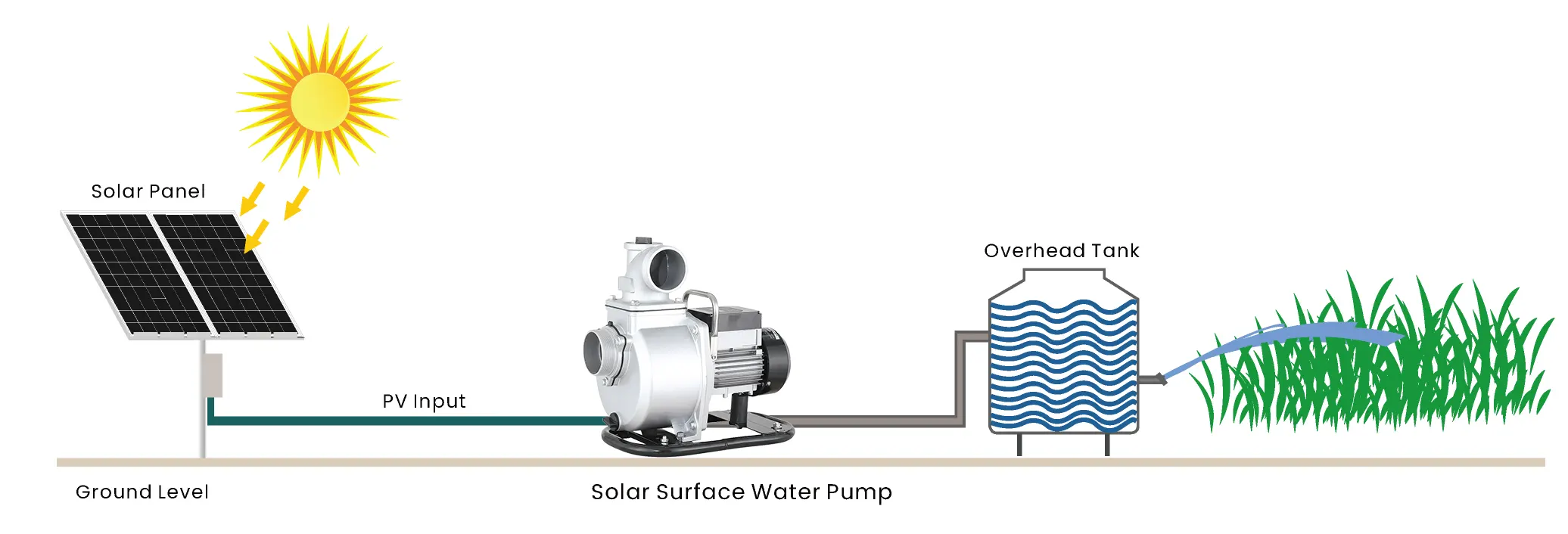
In many cases, a solar surface pump is suitable when the water source is a pond, river, tank or shallow source near the fish farm. Therefore, it is useful for water transfer, pond filling, pond circulation and water supply between nearby storage points.
However, a solar submersible pump is more suitable for deep wells and boreholes. Because it works under water, this pump pushes water upward from the source. For that reason, this type of pump is often used when a fish farm depends on underground water or needs water delivered to an elevated tank before gravity distribution.
WHC Solar provides solar water pump product lines for surface pumping and submersible pumping applications. Buyers can review the WHC Solar water pump supplier page to understand available pump series and complete solar pumping solution support.

How to Match Solar Panels With a Pump Controller
A complete solar water pump system normally includes solar panels, pump controller, pump body, cables, pipes and installation accessories. For African aquaculture projects, the pump controller is especially important because it helps the system use solar power efficiently. In addition, it protects the pump during abnormal conditions.
For this reason, WHC Solar product training materials emphasize MPPT controller matching, pump working voltage range and solar panel configuration. Before ordering, buyers should check that the solar panel Voc does not exceed the pump controller limit. Also, they should check that the panel Vmp works inside the required operating voltage range.
For many pump systems, solar panel power should be matched above the pump power according to the supplier’s configuration guidance. For higher-power AC pump systems, WHC Solar training materials show that solar array sizing may need a higher ratio to support stable pump operation under real sunlight conditions. Finally, the supplier should confirm the final configuration based on the exact pump model, controller input voltage, head and flow requirement.
Supplier Checklist for African Aquaculture Buyers
A good solar water pump supplier should do more than quote a pump model. Instead, the supplier should help buyers match the pump, controller and solar panels as a working system.
| Selection Point | What to Check | B2B Value |
|---|---|---|
| Pump range | Surface pump, submersible pump, self-priming pump and deep-well pump options. | Distributors can cover more local aquaculture and farm applications. |
| Controller quality | MPPT control, LCD display, water shortage protection and waterproof design. | Better controller protection can reduce service complaints. |
| Material and durability | Stainless steel or corrosion-resistant hardware, motor quality and bearing quality. | Important for humid fish farm environments and long outdoor operation. |
| System matching support | Panel quantity, voltage range, cable size and pump controller matching. | Helps installers avoid wrong voltage and weak pumping performance. |
| Spare parts and service | Controller replacement, impeller support, installation guidance and troubleshooting. | Protects distributor reputation after sale. |
| Packaging and batch supply | Wooden package, clear labels, complete accessories and stable batch delivery. | Supports wholesalers serving multiple farm projects. |
Common Mistakes When Buying Solar Pumps for Fish Farms
First, some buyers select the pump only by horsepower or wattage. For example, a 900W pump and another 900W pump may have different head and flow performance. Therefore, buyers should compare pump curves, not only product names.
Second, some buyers ignore the water source. In this case, a surface pump may work well for pond-to-pond circulation but may not fit a deep-well water supply project. By contrast, a submersible pump may be necessary when the source is far below ground level.
Third, buyers sometimes underestimate controller protection. After installation, aquaculture farms often operate in wet, hot and dusty environments. Therefore, a controller with MPPT function, clear display and protection features can make installation and troubleshooting easier for local technicians.
Finally, some buyers purchase a pump without panel matching support. If the solar array voltage is wrong, the pump may start poorly, stop frequently or fail to reach expected flow. As a result, buyers should request a complete solar water pump configuration, not only a pump price.
What WHC Solar Offers for Solar Water Pump Projects
As a full solar energy solution provider, WHC Solar supports project buyers with complete system planning. For solar water pump projects, the company supplies complete solar pump solutions that can include pump, controller, solar panels and configuration support.
In addition, WHC Solar product information highlights DC brushless motor technology, MPPT controller matching, surface pump and submersible pump options, self-priming pump models, stainless steel hardware and water shortage protection. The WHC Solar surface pump page shows surface pump products for farm and water transfer applications.
Moreover, WHC Solar can support buyers who need product customization for pump head, flow, appearance and packaging. Buyers can review the WHC Solar customization page for broader product customization information.
For project references, buyers can also review the WHC Solar water pump case page. However, each aquaculture project should still be sized according to its own water source, head, flow and operating hours.

How Distributors Can Build Solar Pump Packages for Aquaculture Demand
Distributors and wholesalers should not stock only one pump model. Because fish farm demand can vary by water source, pond size, pipe distance and operating method, one model is rarely enough. Therefore, a more practical stock plan may include several pump sizes, controllers, common cable accessories and solar panel combinations.
For small aquaculture ponds, buyers may ask for simple pond filling or circulation. However, larger farm clusters may need several pumps for different ponds, storage tanks and water channels. Meanwhile, borehole-fed farms may need a submersible pump and a stronger solar array.
In addition, a good wholesale package should include quotation questions. Before recommending a model, sales teams should ask customers about flow rate, head, water source, pipe distance and operating hours. As a result, the quotation becomes more professional and the risk of wrong product selection is lower.
FAQ
What type of solar water pump is suitable for fish farms?
It depends on the water source and pumping task. A solar surface pump is often suitable for pond, river, tank and shallow water transfer. A solar submersible pump is more suitable for boreholes, wells and deep water sources.
Can a solar water pump support aquaculture water circulation?
Yes, it can support daytime water circulation, pond filling, water transfer and partial water exchange. However, the supplier must match flow rate, head, controller and solar panel capacity according to the project.
What information should African buyers provide before ordering?
Buyers should provide water source, total head, required flow rate, pipe distance, daily working hours, water quality and site photos. These details help the supplier recommend the correct pump model and solar panel configuration.
Should fish farm buyers choose a complete solar water pump set?
For B2B projects, a complete set is usually safer than buying separate parts from different suppliers. A matched set can reduce voltage mismatch, controller problems and installation delays.
Can WHC Solar support distributors and wholesalers?
Yes. WHC Solar supports distributors, wholesalers, installers and project buyers with solar water pump product supply, configuration guidance and complete solar pumping solution support.
CTA
Looking for a solar water pump supplier for African fish farms, aquaculture ponds or rural water circulation projects? Contact WHC Solar to request pump model recommendations, solar panel matching, controller configuration and wholesale quotation support.