
A cheaper inverter can leave an installer paying for extra controllers, unsuitable motor starts or costly return visits. When choosing a solar inverter supplier, compare the complete system against the customer’s operating needs. This solar inverter comparison explains where low-frequency and high-frequency designs differ, using WHC product documents and practical buying decisions.
The right choice depends on load behaviour, battery limits, solar charging equipment and service arrangements. Weight and headline surge ratings alone cannot establish which unit will suit a project.
What low-frequency and high-frequency actually mean
These labels describe the power-conversion architecture, rather than a different supply frequency for appliances. Both designs can provide 50Hz or 60Hz AC output when specified for the project.
A conventional low-frequency inverter uses a line-frequency transformer in its conversion path. High-frequency designs generally use a different conversion arrangement that avoids the large line-frequency transformer. Cependant, high-frequency does not automatically mean transformerless or non-isolated. Aussi, a low-frequency inverter can still use high-frequency electronic switching.
Le Texas Instruments inverter topology comparison illustrates these distinctions. Its reference circuits explain the architecture; they do not prove the performance of a specific WHC model.
Donc, compare actual models within WHC’s power frequency inverter range and the relevant high-frequency range. Confirm waveform, isolation requirements and approved installation conditions separately.
Solar inverter comparison: match the complete quotation
Use the same load schedule, battery requirements and delivery destination for both offers. Then compare the following items before selecting a model.
| Buying factor | Low-frequency option | High-frequency option | Purchasing decision |
|---|---|---|---|
| Motor starting | Assess the model’s overload curve; transformer construction alone is insufficient. | Assess surge duration and electronic current limits. | Match starting demand and duration, including other running loads. |
| Solar charging | May require a separate controller; confirm the supplied package. | Some hybrid models integrate MPPT, including HVM 5K Plus. | Include controller, protection, wiring and installation labour. |
| Energy losses | Request efficiency and idle-consumption data at relevant loads. | Request the same measurements and operating conditions. | Compare daily battery energy demand, rather than unmatched peak figures. |
| Transport and mounting | Line-frequency transformers can increase size and weight. | Compact models can simplify handling; verify actual packed dimensions. | Price freight, mounting support and site access. |
| Intégration de la batterie | Verify voltage, charging profile and protection coordination. | Verify those items plus any advertised BMS communication. | Obtain model-specific battery and firmware compatibility confirmation. |
| After-sales support | Agree diagnosis, spare parts and repair responsibility. | Agree board replacement, firmware support and return procedures. | Compare the written service offer, rather than assuming either type is easier to repair. |
Neither architecture wins every category. A suitable model combines the required electrical performance with an affordable, serviceable installation.
What the WHC product documents show
HVM 5K Plus: an integrated charging example
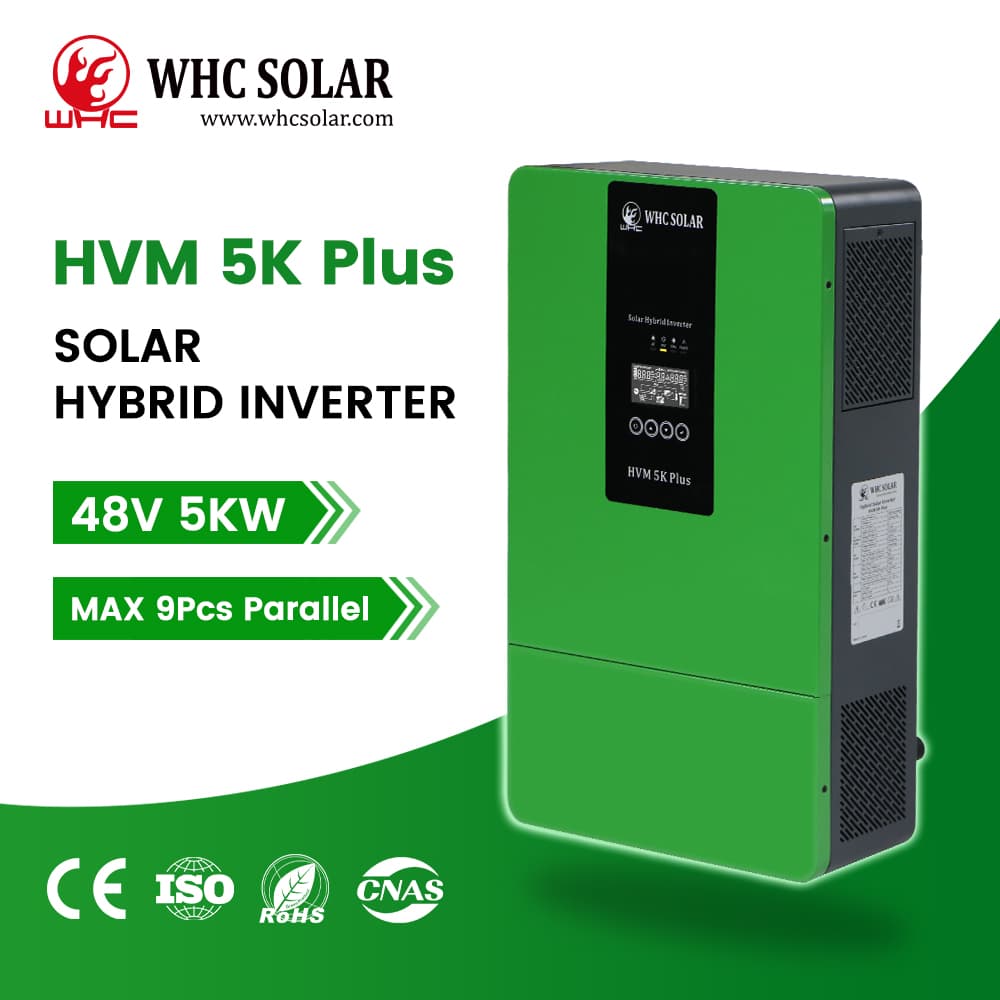
The HVM 5K Plus datasheet specifies 5kW rated output, a 48V nominal battery and a built-in 80A MPPT charger. Its operating MPPT range is 120–450V DC, while the maximum PV open-circuit voltage is 500V. These are different limits; array design must account for temperature and module specifications.
The same document lists 9.5kg net weight and IP21 protection. Optional functions, including BMS communication, require confirmation for the ordered version. Browse WHC’s hybrid solar inverter options when evaluating an integrated package.
The 4–6kW power-frequency series: a different package boundary
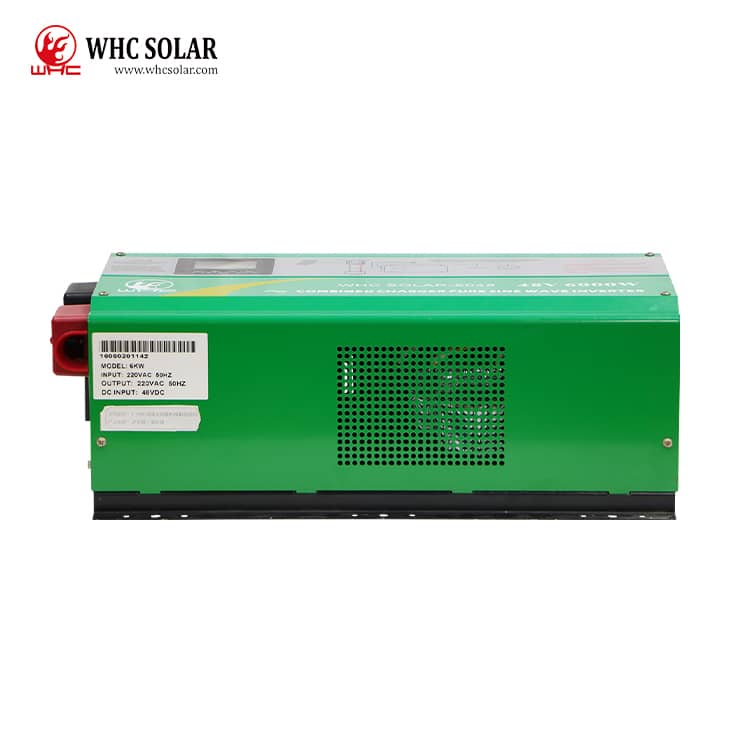
The reviewed WHC manual covers 4kW, 5kW and 6kW models. It lists pure sine wave output and a default 30A battery charging current. It does not establish an integrated solar MPPT specification. Ask whether the quotation includes a separate contrôleur de charge solaire, with its own PV limits and protective equipment.
The manual quotes efficiency above 85% à 80% resistive load. HVM lists maximum battery-mode efficiency of 93% at 48V DC. These conditions differ, so subtracting the figures would not establish an eight-percentage-point operating advantage.
Starting demand and overnight losses can change the choice
HVM’s datasheet lists 10kVA surge power alongside separate battery-mode overload durations: 3 seconds at 130–150% load and 0.2 seconds above 150%. Do not interpret the surge headline as permission to start any 10kVA motor load. Obtain confirmation of the starting duty, battery conditions and applicable protection limits.
De même, the power-frequency manual’s overload entries are protection information, rather than proof that every compressor or pump will start. Starting demand, simultaneous loads, DC cable losses and BMS current limits all affect the result.
For lightly loaded overnight systems, idle consumption also matters. Illustratively, an additional 30W used for 12 hours consumes 0.36kWh. This is a calculation example, not a measured difference between WHC products.
Apply the solar inverter comparison to three project types
The following are illustrative procurement scenarios, not named WHC installations or reported project results.
Nigeria: a repair workshop with intermittent motor loads
Prioritise verified starting performance and simultaneous demand. A low-frequency model may be a candidate, but approve it only after reviewing the actual starting duty. Include a high-frequency alternative if its documented performance meets the same requirement.
Ghana: a service office with mostly electronic loads
An integrated high-frequency package may reduce separate equipment and installation work. Compare usable battery energy, transfer behaviour and daytime charging capacity. Comme le U.S. Department of Energy’s inverter guidance explains, outage operation depends on the inverter and system being designed for it.
Cameroun: a remote commercial service point
Transport access and repair arrangements may outweigh a small purchase-price saving. Compare packed weight, local spares and replacement lead times. Also define generator charging limits and operating priorities before choosing the package.
Choose a solar inverter supplier on complete project value
Chez WHC Solaire, we recommend requesting comparable packages rather than buying by topology label. Partagez votre planning de chargement, starting requirements, battery details, solar array proposal and installation conditions. Utilisez le solutions solaires commerciales discussion to define equipment scope and operating priorities.
A useful solar inverter comparison ends with a documented choice: adequate output, compatible charging, realistic installed cost and an agreed service route. Select the solar inverter supplier that can explain those items for the exact model offered.
Questions fréquemment posées
Is a low-frequency inverter always better for motors?
Non. Evaluate starting demand against the model’s time-dependent overload capability, battery current limits and other connected loads.
Does high-frequency mean a different AC output frequency?
Non. The label concerns conversion architecture. Confirm the required 50Hz or 60Hz output for the actual model.
Can I connect solar panels directly to either type?
Only through a suitable integrated or external solar controller. Confirm PV voltage, current and charging limits before ordering.
Can both types work with lithium batteries?
Some models can. Obtain confirmation of battery voltage, charging settings, BMS limits and communication compatibility where required.
What should an installer compare beyond unit price?
Include controllers, protection, cabling, freight, montage, commissioning and service arrangements. Use the same equipment boundary for both offers.
Request a model-specific inverter and solar package proposal
Send WHC Solar your country, charger la liste, motor-starting information, battery model, solar array details and order quantity. Request a B2B inverter comparison and complete system quotation for your installation requirements.