
Choosing a solar water pump supplier starts with a practical question: must the pump run after sunset, or must water simply remain available? African irrigation contractors need that distinction before comparing quotations. Solar pump water storage can shift daytime pumping into evening irrigation. Batteries instead keep compatible electrical equipment running when solar production falls.
Neither option fixes an undersized borehole or guarantees irrigation pressure. Compare both against daily water demand, seasonal source yield and the delivery schedule.
Define water demand before choosing storage
Prepare daily demand in cubic metres, peak delivery flow and irrigation times. Include crop-season changes and any shared livestock supply. Then record the dry-season dynamic water level, pipeline route and required outlet pressure.
Le World Bank solar pumping design overview identifie la demande en eau, stockage, head and solar irradiance as design inputs. For procurement, translate those inputs into a duty point and daily delivery requirement.
Par exemple, 30 m³/day over six assumed effective pumping hours requires an average 5 m³/heure. This is illustrative screening, not a production guarantee. Verify seasonal output using local irradiance, the pump curve and operating head. Six daylight hours do not automatically mean six hours at rated flow.
For a borehole, assess solar submersible pump options against the dynamic pumping level, not total drilled depth. Total dynamic head also includes discharge elevation, pipe losses and required delivery pressure, without double-counting them.
Solar pump water storage: separate volume from pressure
A tank or reservoir lets the solar water pumping system collect water during daylight. Irrigation can then draw from that reserve. Cependant, usable storage excludes dead volume and water below the minimum operating level.
Suppose a project needs 20 m³ between sunset and the next reliable refill period. Adding an illustrative 5 m³ contingency gives 25 m³ of usable storage. This is not the required gross tank size. Check the full daily water balance, starting level and cloudy-period requirement before specifying construction.
Check gravity delivery before removing the booster pump
A ground-level tank may store enough water but provide insufficient pressure for sprinklers or filtered drip lines. Check the lowest usable water level against the highest irrigation outlet. Account for filter and pipe losses. If a booster remains necessary at night, it still needs an electrical supply.
Elevating the tank can improve gravity pressure, but adds structure and foundation costs. It also raises the source pump’s delivery head. Compare that civil-work scope with battery-backed boosting rather than assuming water storage is always cheaper.
When battery storage deserves a separate quotation
Battery storage is worth evaluating when pressurised irrigation cannot move into daylight, or when other critical loads also need backup. First confirm the electrical architecture. A PV-input MPPT pump controller is not automatically suitable for direct battery connection.
WHC’s product training distinguishes built-in and external pump controllers, and includes AC/DC pump options. These are different configuration routes, not interchangeable battery interfaces. Obtain model-specific approval for battery voltage, inverter output, démarrage du moteur, protections and control behaviour.
For illustration, a pump drawing 2 kW electrically for three hours needs 6 kWh at its input. Assuming an 80% usable battery window and 90% discharge-path efficiency gives 6 ÷ (0.80 × 0.90) = 8.33 kWh nominal. This preliminary calculation excludes auxiliaries, vieillissement, temperature effects and additional reserve.
Separately verify continuous power, starting capability, BMS current limits and charging capacity. A sufficient kWh rating does not prove that the pump will start. De même, backup operation must leave enough next-day solar capacity for both irrigation and battery recharge.
Compare supply architectures on the same water duty
Ask each solar water pump supplier to quote against the same daily volume, delivery pressure and operating schedule. Use this matrix to identify missing scope.
| Architecture | Best-fit requirement | Scope to price | Decision gate |
|---|---|---|---|
| Daytime pumping without a buffer | Flexible irrigation during adequate sunlight | PV, pompe, controller and distribution | Can crops tolerate variable delivery? |
| Daytime pumping with water storage | Water needed outside pumping hours | Tank, civil works, valves, level controls and any booster | Are usable volume and outlet pressure sufficient? |
| Battery-backed pumping or boosting | Fixed nighttime pressure or electrical loads | Batterie, compatible conversion, enclosure and protections | Are starting, runtime and recharge verified? |
| Approved AC/DC backup route | Existing reliable alternative power | Approved supply interface, switching and operating costs | Is the alternative source available when required? |
Compare maintenance over the same evaluation period. Include tank cleaning, leakage and exposed-water losses, alongside battery servicing and eventual replacement. Neither storage method creates water when the source yield is inadequate.
Three typical African irrigation decisions
These are planning scenarios, not reported WHC installations or customer results.
Nigeria: vegetable irrigation before sunrise
A contractor can assess daytime filling followed by early-morning gravity irrigation. Confirm emitter pressure and filtration losses first. If gravity cannot satisfy them, quote a booster and its power supply separately.
Ghana: a farm drawing from a surface reservoir
Compare solar surface pump configurations using seasonal source level, suction conditions and field elevation. An expensive tank tower may change the preferred architecture. Confirm access, foundations and cleaning arrangements before accepting a tank-based price.
Cameroun: fixed nighttime sprinkler operation
Where the irrigation timetable requires sustained pressure after sunset, a tank alone may not suffice. Compare approved battery-backed pumping with an available AC/DC alternative. Keep source-yield limits and nighttime staffing in the decision.
What to request from a solar water pump supplier
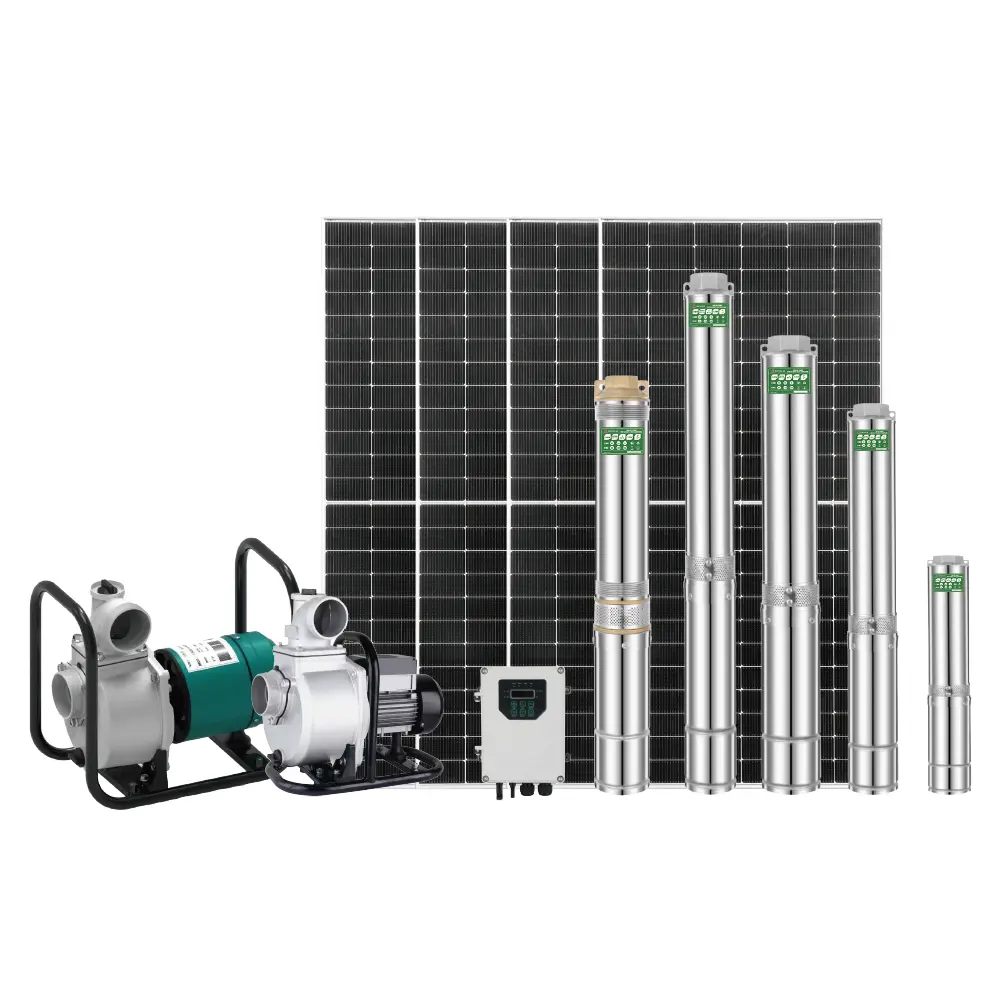
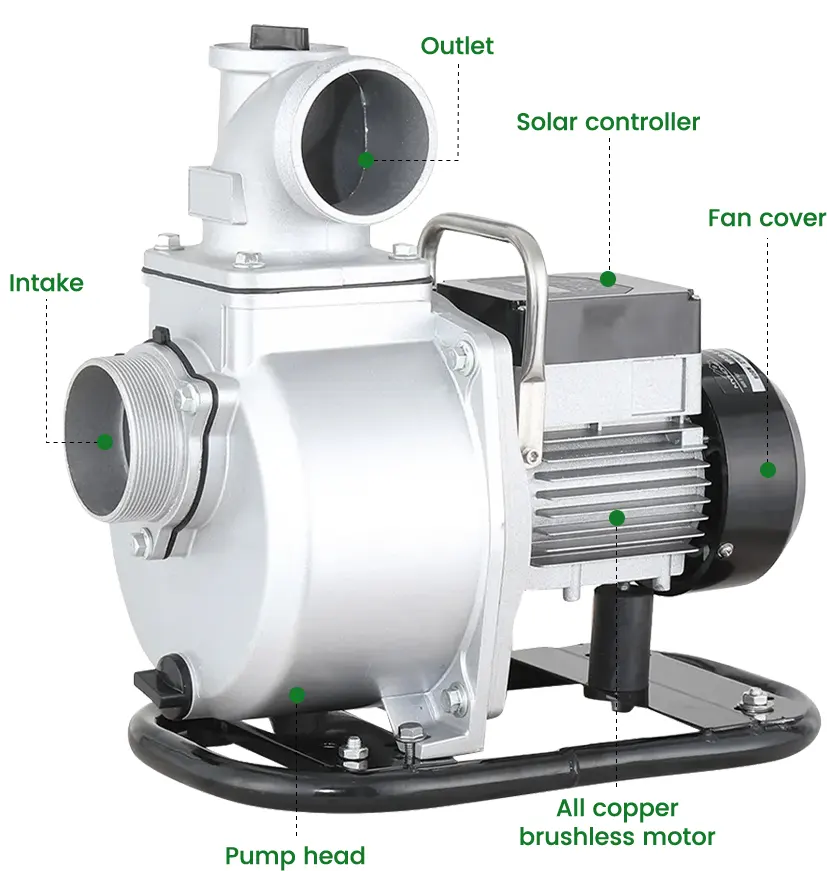
Our procurement recommendation is to compare complete configurations, not pump wattage alone. Whc solaire solar water pump range provides the starting point; the selected model still needs a duty-point check.
Request the pump curve, seasonal delivery estimate, controller limits, storage assumptions and an itemised supply boundary. Identify who supplies tanks, towers, foundations, piping, filters, boosters and backup interfaces. Also request commissioning responsibilities, spare-part references and written warranty terms for the quoted equipment.
Check abstraction permissions and sustainable yield with local specialists. Le World Bank discussion of solar irrigation risks highlights groundwater depletion concerns. More pumping capacity is not a substitute for water-resource assessment.
FAQ
Is water storage always cheaper than batteries?
Non. Tank construction, elevation and booster requirements can change the comparison. Compare complete systems delivering the same water service.
Can a solar pump run at night without batteries?
Only with a suitable alternative power source and approved equipment. Stored water can supply irrigation without running the source pump, if delivery pressure is adequate.
Can batteries connect directly to the pump controller?
Ne présumez pas cela. Obtain written approval for the exact controller, battery and conversion arrangement.
How much water storage should contractors specify?
Calculate the largest cumulative gap between demand and pumping over the design period. Add justified reserve and distinguish usable from gross capacity.
What information makes quotations comparable?
Provide daily volume, duty point, irrigation schedule, seasonal water level, storage location and backup requirements. Require identical supply boundaries.
Request a dry-season pumping configuration
The right solar water pump supplier should explain both the hydraulic and electrical boundaries. Solar pump water storage suits time-shifted delivery only when volume and pressure work together. Batteries deserve consideration where nighttime electrical operation is genuinely necessary.
Send your irrigation requirements to WHC Solar: demande quotidienne en eau, delivery hours, dry-season water level, piping route, outlet pressure and available power. Request a project configuration and itemised B2B quotation comparing the feasible storage routes.