
A warehouse solar quotation can miss expensive work when it starts with panel capacity alone. Roof repairs, long cable routes and switchboard changes may sit outside the equipment price. A practical warehouse solar system solution starts by identifying these conditions before procurement.
For African project developers and commercial installers, the survey should answer three questions: Can the building accept the installation? Where will equipment and cables go? Who will deliver each part of the work?
Define your warehouse solar system requirements
Separate daytime electricity savings from outage protection. Record operating hours, measured demand, electricity bills and generator use. Then identify lighting, matériel de bureau, loading doors, conveyors and charging equipment that need continued operation.
Do not automatically include every forklift charger or motor in the backup circuit. Their operating schedules and power requirements can change the design. Mark essential and nonessential circuits before reviewing a système solaire commercial.
Also confirm who owns the roof and who can approve alterations. For leased warehouses, obtain the landlord’s conditions before committing to mounting hardware or penetrations.
Check warehouse solar system roof readiness
Separate visible condition from structural approval
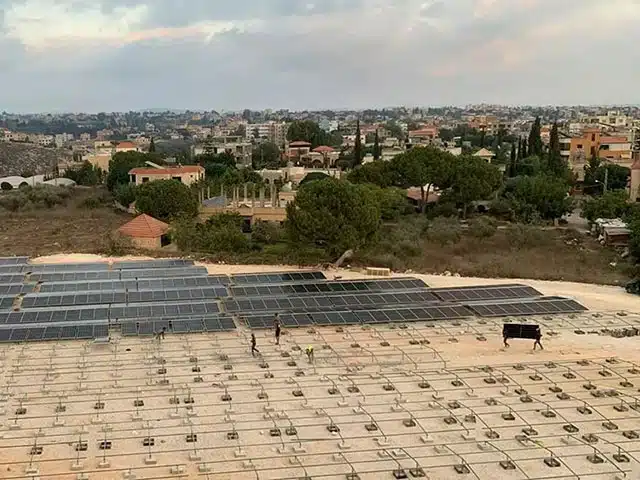
Photograph roof sheets, supporting members, existing equipment, corrosion and signs of leakage. Collect available drawings and maintenance records. A clear roof photograph does not establish spare structural capacity.
A qualified local structural engineer should assess the proposed additional loads, attachment method and site wind conditions. Avoid using a universal roof loading allowance or pole-free mounting assumption across different buildings.
Coordinate repairs, drainage and safe access
Ask whether the roof needs repair or replacement during the intended project life. Resolve waterproofing responsibilities and roof warranty conditions before installation. Record skylights, gutters, drainage outlets and maintenance routes as layout constraints.
Le U.S. Department of Energy’s photovoltaic installation guidance highlights structural suitability, roof condition and cable management. These are useful survey principles, not substitutes for local engineering requirements or approvals.
Trace the electrical connection and cable route
Obtain an updated single-line diagram and inspect the proposed connection point with the site electrical team. Record supply configuration, switchboard condition, available space and existing protection. The engineer must confirm suitable equipment ratings and coordination.
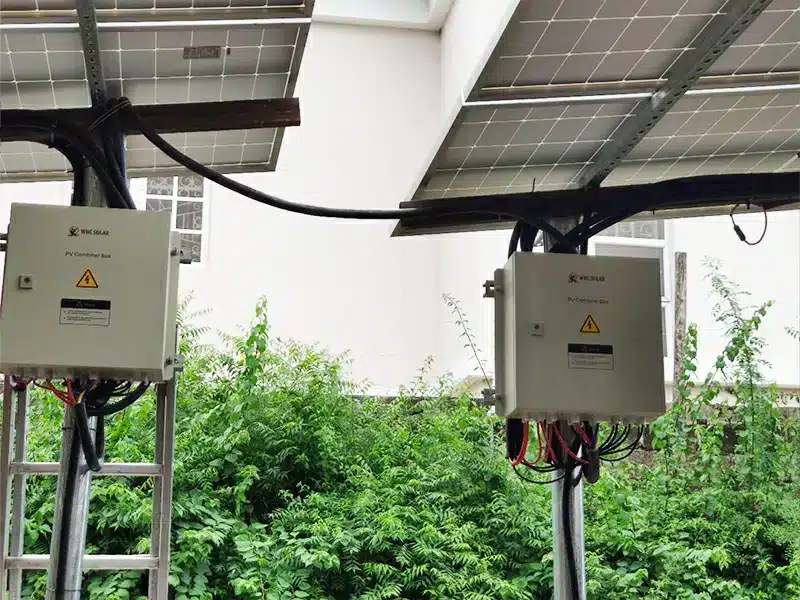
Measure the actual route between the array, onduleur, battery location and distribution board. Include vertical runs, roof crossings and diversions around working areas. Straight-line distance alone is not a reliable cable allowance.
Suivant, identify who provides trays, supports, penetrations, weather sealing and any required fire stopping. Agree shutdown windows with warehouse operations. Loading docks and emergency routes must remain usable under the agreed work plan.
Reserve space for warehouse solar system equipment
Review delivery access and equipment locations alongside the roof layout. Check gates, unloading areas, door openings and the complete movement route. An accessible loading dock does not guarantee access to the final equipment position.
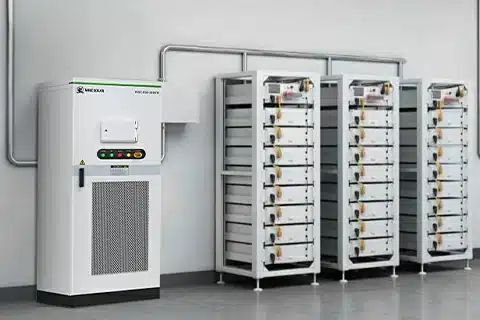
As one product example, the WHC-ESS-125KW inverter datasheet lists a 125 kW rated output and dimensions of 800 × 2000 × 1100 mm, expressed as width × height × depth. Its cabinet footprint is therefore 0.88 m².
That figure excludes batteries, service clearances, door opening space and protective equipment. It is not the required installation area or a warehouse sizing recommendation. Obtain the current installation drawing for the selected onduleur solaire.
The same datasheet specifies intelligent air cooling. Par conséquent, layout reviews must address ventilation and the manufacturer’s clearances. Also assess water exposure, poussière, vehicle impact, floor loading and emergency access for the complete system.
Confirm warehouse solar system backup interfaces
Existing solar panels do not automatically provide power during a grid outage. As explained in the Department of Energy’s inverter and grid-services overview, operation without the grid requires an appropriately designed system.
For warehouse backup, specify the protected circuits, isolation arrangement and acceptable interruption. Where a generator remains, request an agreed control sequence and interface responsibilities. Do not treat battery capacity alone as evidence of safe islanded operation.
Compare warehouse solar system installation scope
Use the following checklist when reviewing a warehouse solar system. An equipment-only quotation can be suitable if the local contractor’s work is clearly budgeted. A broader proposal still needs explicit exclusions and acceptance criteria.
| Scope item | If the offer covers equipment only | Written clarification to request |
|---|---|---|
| Roof assessment and preparation | Appoint the local assessor and roofing contractor. | Who approves structure, repairs and waterproofing? |
| Mounting and cable routes | Price local supports, routing and installation separately. | Which mounting parts, cable lengths and penetrations are included? |
| Unloading and equipment placement | Arrange handling, access preparation and any foundations. | Where does delivery end, and who handles final placement? |
| Electrical integration | Assign switchboard work and local approval tasks. | Who supplies protection, interfaces and shutdown labour? |
| Commissioning and handover | Confirm local testing and supplier support arrangements. | Which tests, drawings, settings and training complete acceptance? |
Three illustrative African warehouse survey priorities
These examples describe planning situations, not completed WHC projects.
Nigeria: daytime distribution warehouse
For a warehouse operating mainly during daylight, start with measured daytime demand and usable roof area. Confirm delivery-lane access before selecting equipment positions or scheduling lifting work.
Ghana: evening sorting and dispatch
If sorting continues after sunset, identify the lighting, scanning and dispatch circuits that need backup. Survey the route to a separate essential-load board instead of assuming whole-building backup.
Cameroun: warehouse with an ageing switchboard
Where the existing board needs upgrading, establish that scope before final procurement. Coordinate electrical repairs, isolation and commissioning with the owner’s operating schedule.
Prepare a warehouse solar system survey package
Envoyer l'emplacement du site, roof drawings, condition photographs and structural assessment status. Include demand records, the single-line diagram, proposed cable routes, equipment-space measurements and delivery restrictions.
Also state the backup requirement, détails du générateur, shutdown windows and intended local installation responsibilities. WHC Solar can discuss an integrated solar solution against the information supplied. Local structural approval and installation responsibilities must remain explicit in the contract.
Questions fréquemment posées
Does a warehouse solar system need a structural roof assessment?
Oui. A large roof alone does not establish suitability. Structural capacity, état du toit, ombres, drainage and safe access can limit the usable installation area.
Should roof repairs happen before panel installation?
Resolve identified roof defects and the repair plan first. Coordinate the roofing contractor, system designer and owner before approving the final installation sequence.
Does adding batteries guarantee uninterrupted operation?
Non. Backup performance depends on the complete design, controls, isolation arrangement and protected loads. Specify the required interruption limit and verify it during acceptance testing.
Can photographs support a fixed installation quote?
They support preliminary review but cannot replace missing structural information, electrical measurements or verified routes. List unresolved items as quotation assumptions or exclusions.
Request your warehouse solar system solution
Contacter WHC Solaire with your warehouse survey package and procurement scope. Request an equipment proposal with stated assumptions, interface requirements and exclusions before approving the installation budget.