
A school solar system can fail even when the inverter rating looks large enough. The usual cause is an incomplete load schedule. Classrooms mainly consume power during the day, while dormitories, security lighting and refrigeration continue after sunset. ICT equipment needs stable power, and a borehole pump may add a large motor load for several hours.
For an EPC contractor or school owner, the first purchasing decision should therefore be the load strategy rather than the equipment brand. Un fiable solution de système solaire must identify when each load operates, which circuits need backup and which activities can move into solar production hours.
Le Tracking SDG 7 Energy Progress Report 2025 reported that 565 million people in Sub-Saharan Africa lacked electricity access in 2023. It also reported that 451 million rural residents in the region remained without electricity. This operating environment makes careful load prioritization especially important for rural and peri-urban schools.
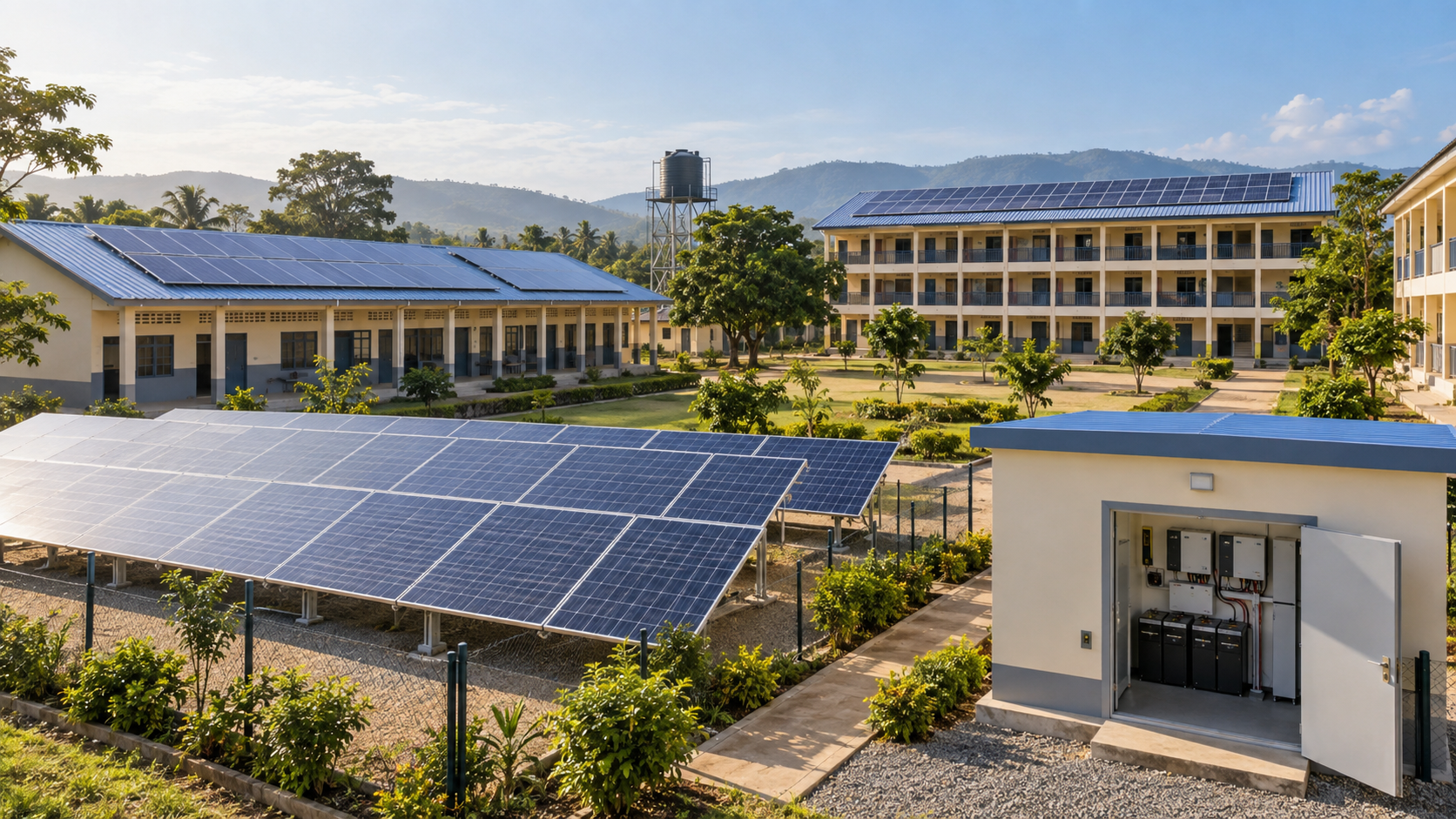
Why a School Solar System Must Follow the School Timetable
A connected-load list only shows the total wattage printed on equipment labels. It does not show whether the equipment runs at the same time. Adding every appliance rating can create an unnecessarily expensive proposal. Ignoring coincident loads can produce an undersized inverter that trips when a pump, refrigerator or workshop motor starts.
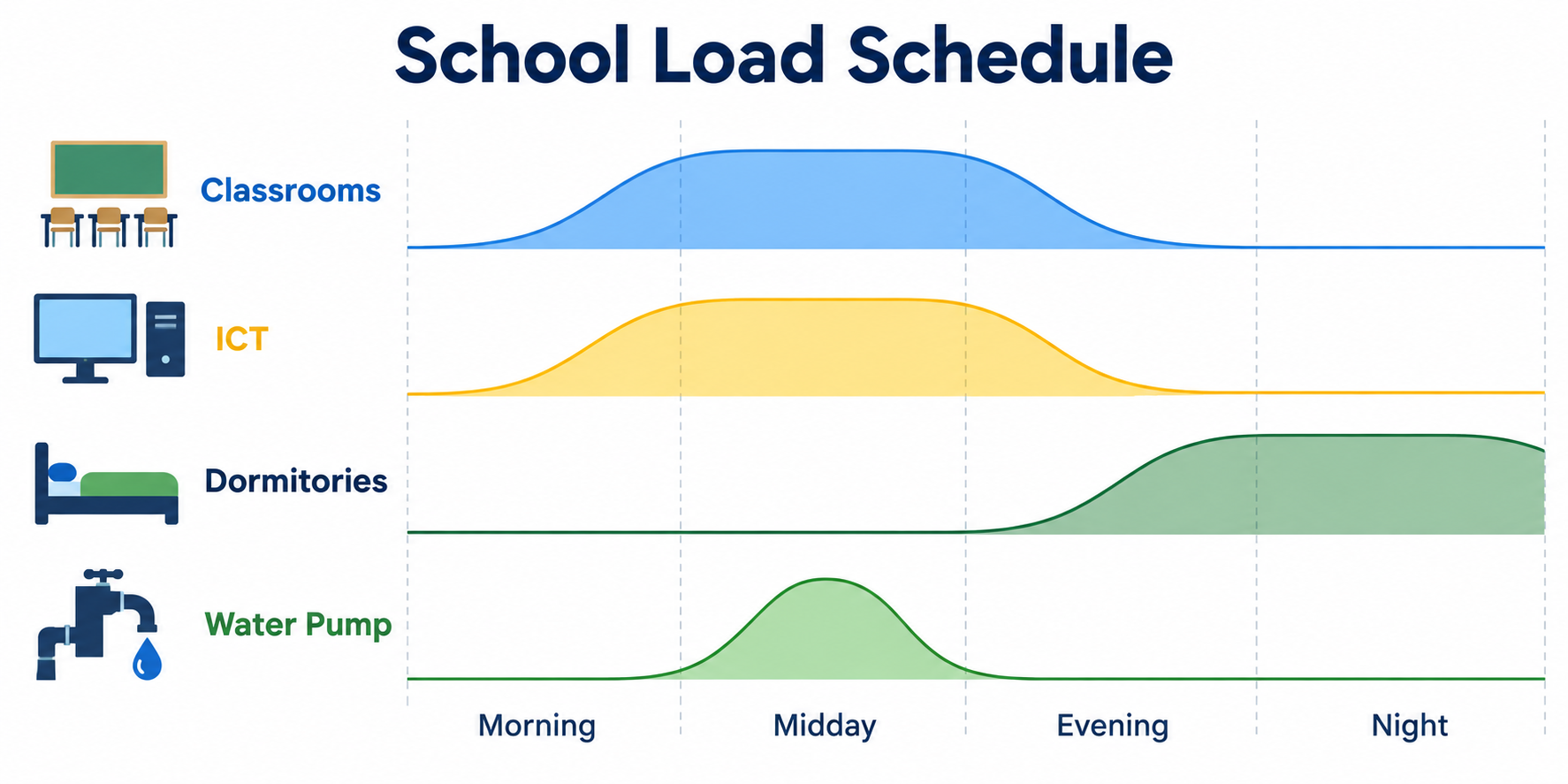
The project team should map the operating schedule before selecting equipment. Classroom lights and fans normally align with daytime PV generation. Dormitory lighting creates an evening battery load. A computer laboratory may create a concentrated daytime demand, while network equipment may need continuous power. A water pump can often operate near midday and fill a storage tank instead of consuming battery energy at night.
Le UNESCO Institute for Statistics education framework for Africa includes school access to electricity, internet and computers among its education-service indicators. A school power plan should therefore protect the equipment that enables teaching and connectivity, rather than treating every campus appliance as equally critical.
Build a School Solar System Load Map Before Sizing Equipment
Pour les projets EPC, we recommend dividing the campus into load groups. This makes the quotation easier to verify and helps the school manage the system after installation.
| Load Group | Typical Schedule | Electrical Characteristic | Priorité de sauvegarde | Configuration Action |
|---|---|---|---|---|
| Classrooms and administration | Mainly daytime | Éclairage, Ventilateurs, printers and office equipment | Medium to high during school hours | Align operation with PV production and separate essential office circuits |
| ICT room and communications | Daytime, with selected equipment operating continuously | Sensitive electronic loads that require stable voltage | Haut | Use a protected critical-load circuit and confirm inverter output quality |
| Dormitories and security | Evening and overnight | Éclairage, Ventilateurs, charging and security equipment | Haut | Include these loads in battery-autonomy calculations |
| Borehole or transfer pump | Scheduled daytime operation | Motor startup current and hydraulic duty requirements | Usually deferrable if water storage is available | Pump water during strong sunlight and store water in a tank |
| Refrigeration | Cycling throughout the day and night | Compressor startup and variable duty cycle | High where food or medicine depends on it | Measure duty cycle and include startup demand in inverter checks |
| Kitchen and vocational workshop | Short, concentrated operating periods | Heating appliances, motors or welding equipment | Conditional | Schedule heavy loads or place them outside the essential backup circuit |
Size the School Solar System from Both kW and kWh
Inverter power and battery energy answer different questions. The inverter rating in kilowatts determines how much simultaneous load the system can operate. Battery capacity in kilowatt-hours determines how long selected loads can continue when PV, grid power or the generator is unavailable.
Calculate Daily Energy, Not Only Connected Power
Estimate each load with the following planning formula:
Daily energy = equipment power × quantity × operating hours × duty factor.
Whenever possible, replace estimates with measured data. The team should record daytime peaks, evening demand and motor-starting events. The inverter must cover the expected coincident load and the applicable surge requirement stated in the selected equipment datasheet.
Calculate Battery Autonomy from Critical Loads
Assume, for illustration, that essential dormitory, sécurité, ICT and refrigeration loads average 7 kW for five hours. They require 35 kWh of delivered energy. If the preliminary design uses an 80% usable battery window and a 90% delivery allowance, the estimated nominal capacity is:
35 kWh ÷ 0.80 ÷ 0.90 = approximately 48.6 kWh.
This is a planning example, not a final product recommendation. The engineer must replace the assumed usable window and efficiency with the selected battery, BMS and inverter data. Pour référence, a 51.2V 100Ah battery has 5.12 kWh of nameplate energy because 51.2 × 100 = 5,120Wh. Usable energy depends on the approved operating limits.
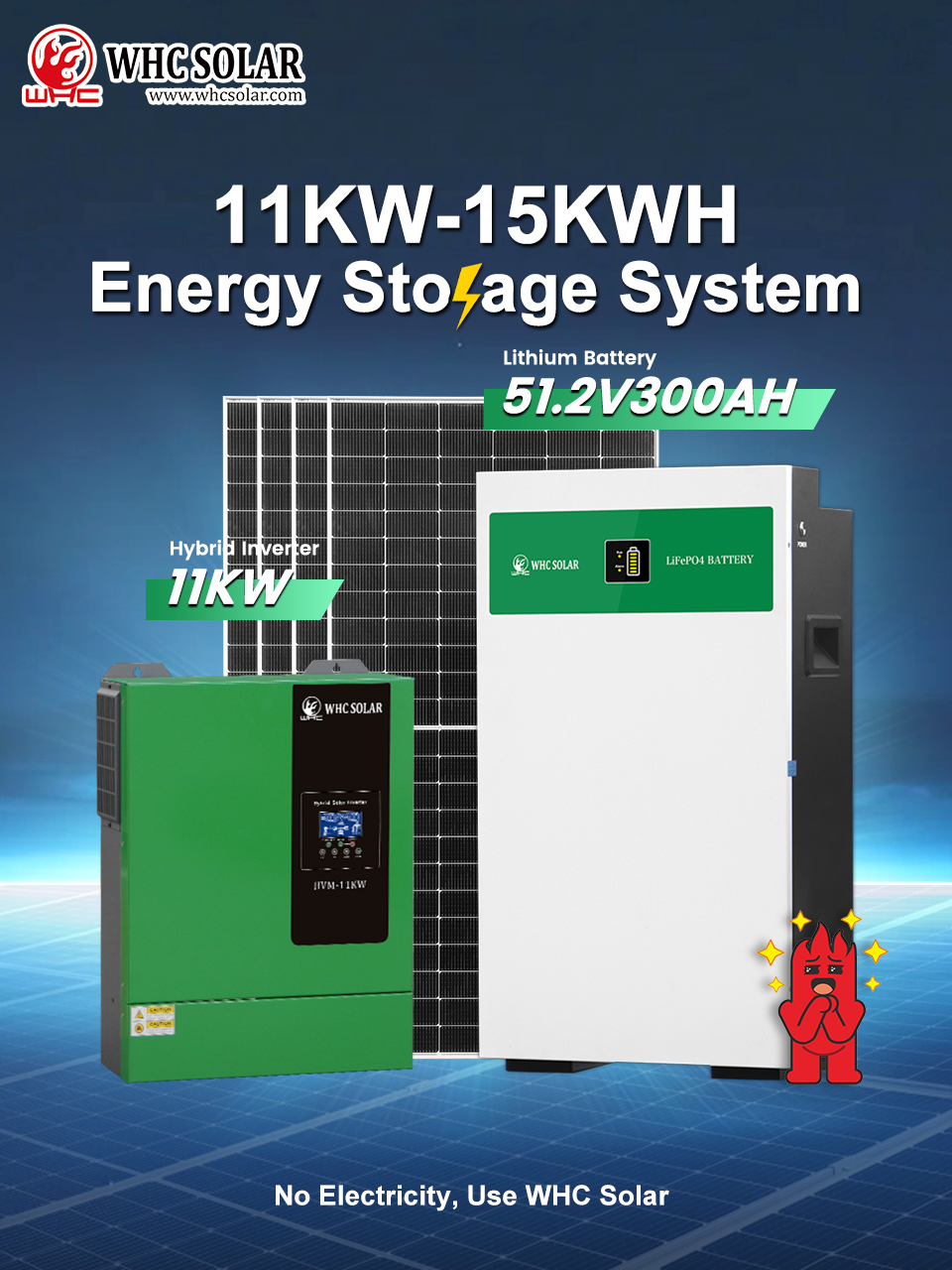
WHC Solar offers several solar lithium battery configurations. The final selection must confirm voltage, limites actuelles, Communication GTB, parallel limits and compatibility with the chosen inverter.
Check the PV Array Against the Real Charging Window
PV sizing should use site-specific solar resource data, system losses and the school timetable. The array must support daytime loads while leaving enough energy to recharge the battery. Panel-string design must also remain within the inverter or MPPT controller’s maximum PV voltage, current and power limits. Series strings affect voltage, while parallel strings increase current.
Schedule the Water Pump as a Controllable Daytime Load
A common design mistake is adding the pump to the nighttime battery calculation without first checking whether the school can store water. In many projects, the system can operate the pump during strong solar-production hours and fill an elevated or ground-level tank. The stored water then serves the school outside pumping hours.
The EPC contractor must still obtain the required flow, total dynamic head, borehole level, pipe length and pump-motor data. The electrical design must check startup current, cable voltage drop, dry-run protection and tank-level control. A water tank can reduce electrical storage demand, but it cannot correct an incorrectly selected pump.
Compare Off-Grid and Hybrid School Solar System Architectures
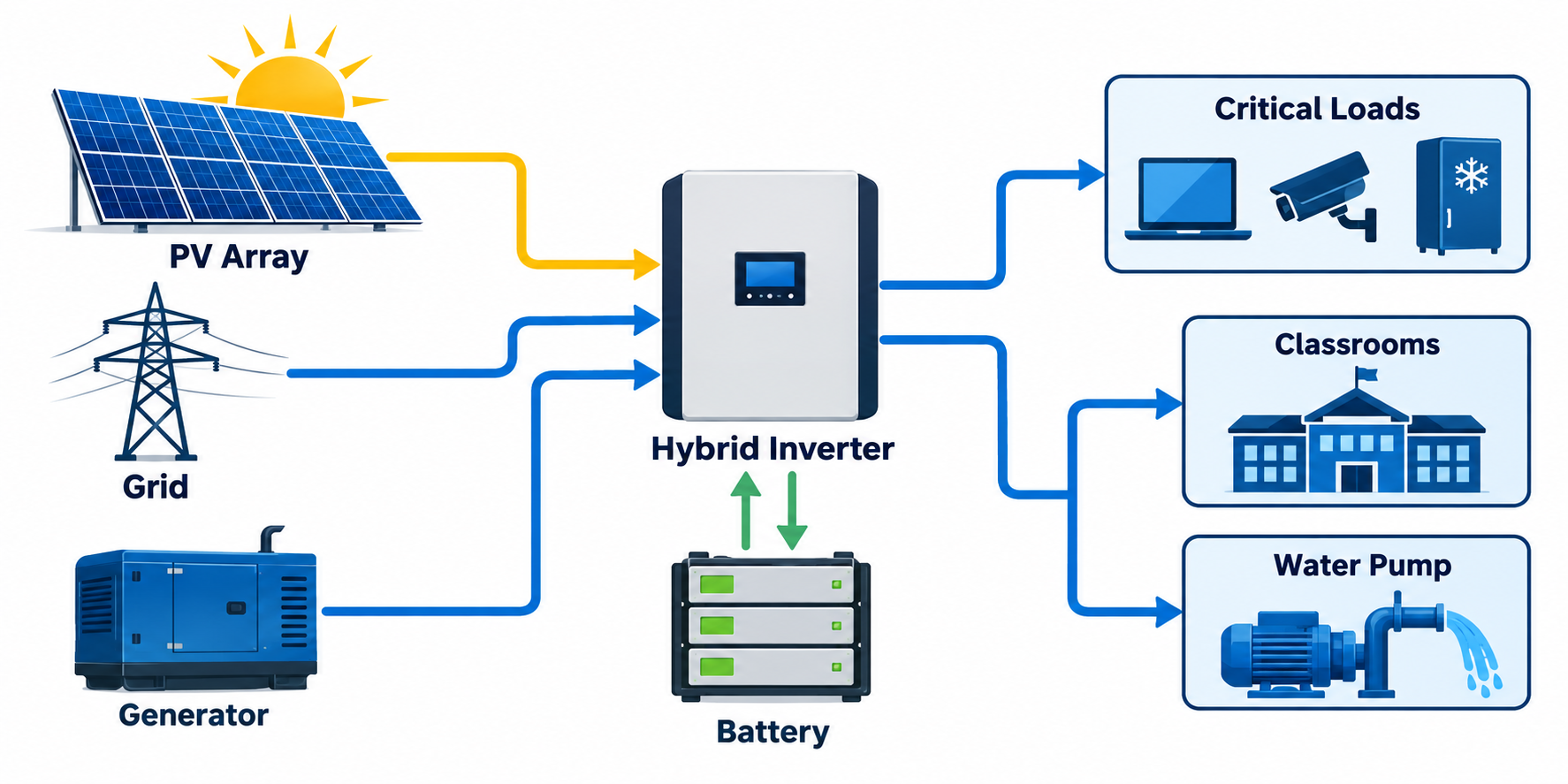
An off-grid system relies on PV, batteries and usually a backup generator. It suits sites without a dependable utility connection. A hybrid system can coordinate solar power, batteries, grid input and generator charging. It may suit urban or peri-urban schools that have a grid connection but experience frequent outages.
The correct architecture depends on outage duration, generator condition, fuel availability and the school’s tolerance for interruption. Le Analyse du marché des énergies renouvelables de l’IRENA pour l’Afrique emphasizes that Africa’s regions need resilient energy systems suited to local conditions rather than one standard approach.
For either architecture, the design should separate critical and noncritical distribution boards. ICT, sécurité, selected lighting and essential refrigeration may remain on the protected circuit. Electric cooking, workshop machines or other heavy loads may operate only during specified periods.
Le WHC hybrid inverter range and broader WHC solar energy system portfolio provide starting points for configuration. The project engineer must verify the exact model’s phase, puissance de sortie, Plage d'entrée PV, battery voltage and generator or grid functions.
Three Typical African School Project Scenarios
Rural Day School
A rural day school may prioritize classroom lighting, Ventilateurs, administration, an ICT room and a borehole pump. Most consumption occurs during daylight. The design can schedule pumping and computer-lab use during PV production, while the battery supports communications, security and limited evening activities.
Boarding School
A boarding school has a larger nighttime requirement. Dormitory lighting, Ventilateurs, chargement, security and refrigeration continue after classes. Battery autonomy becomes a major procurement factor. The quotation should also show which loads disconnect when the battery reaches its reserve threshold.
Technical or Vocational School
A technical school may operate motors, tools, compressors or welding equipment. These loads require a separate surge and phase review. The EPC contractor may schedule workshop operation during the strongest solar hours or retain generator support for equipment that would otherwise enlarge the inverter and battery unnecessarily.
Supplier RFQ Checklist for a School Solar System Solution
Before requesting a quotation, provide the supplier with:
- A load list showing quantity, puissance nominale, operating hours and startup characteristics.
- The school timetable, boarding schedule and holiday operating requirements.
- The site voltage, frequency, phase configuration and available grid connection.
- Existing generator rating, condition and expected operating role.
- Required battery autonomy for each critical-load group.
- Pump flow, tête, borehole and motor information.
- Roof or ground space, cable routes, equipment-room conditions and expansion plans.
- Required drawings, dispositifs de protection, conseils d'installation, training and spare-parts scope.
In our experience with project quotations, unclear load data creates more risk than choosing between two nearby equipment sizes. A supplier should explain the proposed load priority, kW and kWh calculations, PV-string limits, battery operating assumptions and expansion method. A quotation that only lists inverter power and battery capacity is not a complete school energy plan.
How WHC Solar Supports School Solar Projects
WHC Solar works as a full solar energy solution provider for distributors, installers and EPC contractors. Project support can cover system configuration, correspondance des composants, installation drawings and equipment selection based on the customer’s load information.
Les acheteurs peuvent consulter le WHC solar system case library to understand typical combinations of inverters, batteries and PV modules. These examples should guide discussion rather than replace a site survey. Each school requires its own load schedule, autonomy target and operating priorities.
Conclusion: Build the School Solar System Around Operations
Un fiable school solar system begins with the timetable and critical-load list. The design must separate daytime and nighttime demand, check motor starting, schedule the water pump, size usable battery energy and define how the grid or generator will support the system.
For an African school project, a complete solution de système solaire should include transparent calculations, compatible components, protection equipment, installation documents and a practical expansion plan. These checks give EPC contractors and school owners a stronger basis for comparing suppliers and controlling project risk.
Frequently Asked Questions
What information does a supplier need to size a school solar system?
The supplier needs equipment power, quantité, heures d'ouverture, startup characteristics, site voltage and phase, outage duration, generator information and the required backup time for critical loads. Pump flow and head data are also required when the system includes water pumping.
What is the difference between inverter kW and battery kWh?
Inverter kW indicates how much simultaneous power the system can deliver. Battery kWh indicates stored energy and helps determine backup duration. Both values must match the school’s load profile.
Can the school water pump use the same solar system?
Oui, if the inverter, PV array and protection equipment support the pump. Cependant, the engineer must check motor startup, couler, head and cable requirements. Daytime pumping with water storage can reduce battery demand.
Should a school choose an off-grid or hybrid solar system?
An off-grid design suits locations without a usable grid. A hybrid design suits schools that want to coordinate PV, batteries, grid power and a generator. The decision depends on grid reliability, fuel availability and the required continuity of critical loads.
Can a school solar system expand later?
Expansion is possible only when the initial design allows it. The supplier must confirm inverter parallel capability, battery expansion rules, Communication GTB, PV input limits, cable capacity and distribution-board space before procurement.
Request a School Solar System Configuration
Send WHC Solar your school load list, horaire d'exploitation, required backup hours, pump data, site voltage and generator information. Our team can help EPC contractors, distributors and school project owners prepare a matched configuration and B2B quotation. Contact WHC Solar for a project assessment and quotation.