
A solar system that lowers daytime electricity bills may leave your business without power during an outage. A battery system that supports essential equipment may still need a generator during a long supply interruption. The best solar systems for West African businesses therefore depend on the problem each site needs to solve.
Start with three questions: when does the business use electricity, which loads must keep running, and how often does the generator operate? These answers help owners and EPC contractors compare suitable architectures before choosing equipment capacity.
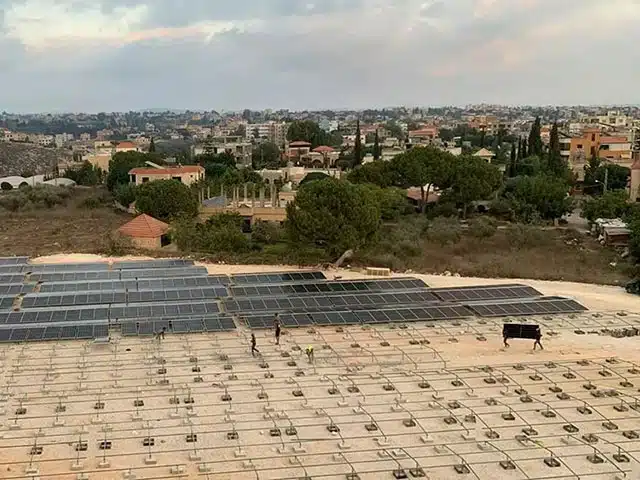
Best solar systems by business objective
Our recommendation is to choose the operating strategy first. Then match the PV array, onduleur, battery and controls to that strategy. The following comparison identifies the strongest starting point for each objective.
| Business priority | Best-fit starting point | Principale limite | Preuve à demander |
|---|---|---|---|
| Reduce daytime grid purchases | Grid-connected PV for on-site consumption | Ordinary grid-connected PV does not provide outage backup. | Load profile, generation estimate and export-control design |
| Keep essential equipment running | PV with battery storage and a backup-capable inverter | Backup duration depends on usable energy, load and recharge opportunities. | Essential-load schedule, outage-mode rating and transfer-time specification |
| Reduce generator operation during unreliable supply | Coordinated solar, battery and diesel hybrid system | Poor generator integration can undermine fuel savings and reliability. | Generator fuel curve, control sequence and operating simulation |
1. Best for daytime savings: solar matched to working hours
Grid-connected PV is a strong starting point when a business uses substantial electricity during daylight hours and already has an acceptable backup arrangement. Solar generation can supply operating loads while reducing electricity purchased from the grid.
Cependant, sizing should follow the daytime load profile. A large monthly bill does not show how much solar the business can use at noon. Weekend closures, seasonal production and shaded roofs can change the result.
Illustrative scenario: a daytime service business in Ghana
Consider a printing business with most equipment running during working hours. Its first comparison should assess PV that follows production demand against PV with storage. If evening consumption is small, storage needs a separate business case based on outages or another measurable benefit.
Par exemple, a steady 10 kW load over five hours consumes 50 kWh. That calculation describes demand during the period; it does not predict the output of a 10 kWp solar array.
Also confirm how the system handles surplus generation. Do not assume the utility permits exports or pays for them. Include any required export limitation and approvals in the proposal.
2. Best for essential-load backup: solar with battery storage
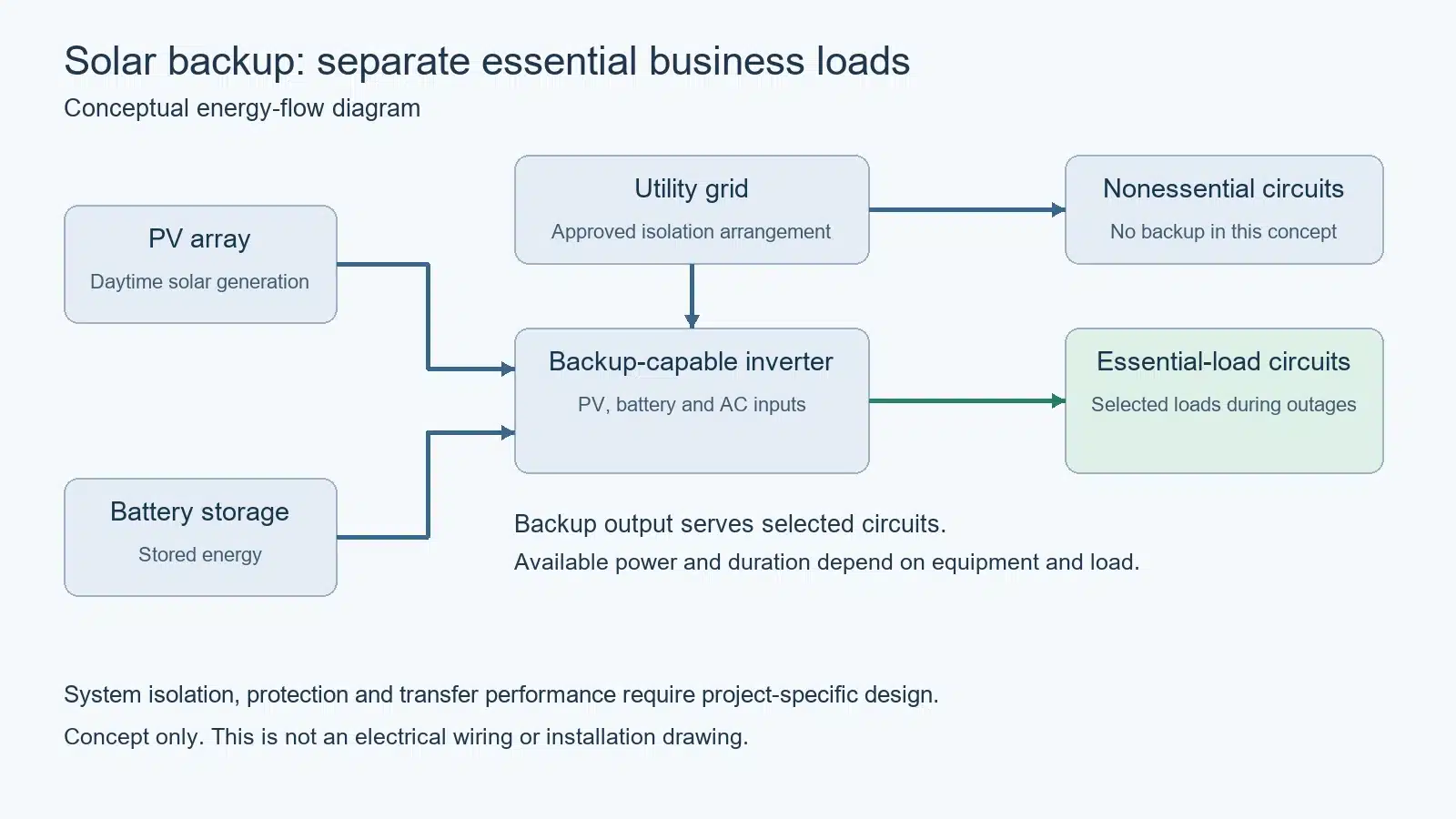
For businesses that lose sales or disrupt operations during outages, solar with batteries can serve selected critical circuits. The key is to define those circuits before selecting battery capacity.
Comme le Australian Government’s battery guidance explique, battery backup depends on the system configuration. Installing storage does not automatically mean every circuit will remain powered.
Illustrative scenario: a Nigerian office with evening operations
An office may need computers, network equipment, lighting and selected cooling after the grid fails. Separating those loads from nonessential equipment can make the backup requirement more manageable.
Suppose essential demand averages 20 kW for four hours. The loads require 80 kWh d'énergie fournie. Battery selection must then account for conversion losses, permitted depth of discharge, operating reserve and capacity loss over time. Un 80 kWh nominal battery is therefore not a four-hour guarantee.
En outre, vérifier la sortie continue, motor-starting capability and phase requirements. Review the proposed onduleur solaire hybride against its battery communication requirements and backup-mode specifications. The word “hybrid” alone does not establish transfer time or compatibility.
3. Best for reducing diesel use: a coordinated hybrid system
Where outages are long or the grid is unavailable, a solar-storage-diesel hybrid system can reduce dependence on generator operation. Solar supplies available daytime energy, batteries support suitable operating periods, and the generator covers remaining demand.
The controls determine how well these sources work together. For background, le NOUS. Conseils sur les onduleurs du ministère de l’Énergie explains how advanced inverter functions support solar integration and appropriately designed outage operation.
Illustrative scenario: a commercial laundry in Senegal
A laundry with pumps, motors and changing production demand needs more than a comparison of daily energy totals. Its contractor should check starting loads, simultaneous operation and which processes can shift into solar hours.
Suivant, define generator start and stop conditions, battery state-of-charge limits and charging power. Confirm whether the proposed arrangement uses generator bypass, controlled charging or parallel operation; these require different equipment and protection.
Fuel savings must use the generator’s measured consumption or manufacturer fuel curve. A lightly loaded generator does not consume fuel as though it continuously delivers its full rated output. Par conséquent, no fixed diesel-saving percentage should appear in the quotation without supporting assumptions.
Match equipment capacity to the operating plan
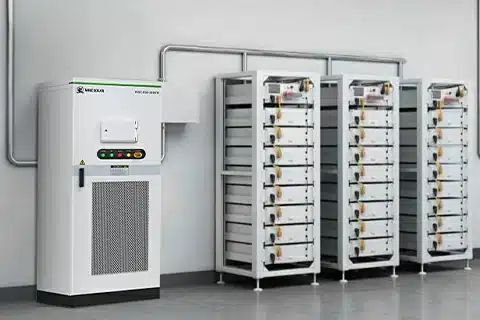
Whc solaire gamme de systèmes solaires commerciaux includes configurations listed as 30 kW/61 kWh and 100 kW/215 kWh. These figures distinguish power from stored energy; they are starting points for configuration discussions, rather than promises of backup duration.
To compare the best solar systems for your site, ask for the exact inverter, battery and PV specifications. Check usable storage, discharge limits, déclassement de température, charging power and the time available to recharge before the next outage.
Compare operating costs for the best solar systems
The best solar systems should fit both the site and the operating budget. Compare equipment, installation, protection, surveillance, maintenance and expected replacement costs over the same evaluation period.
For daytime savings, value the solar electricity the business can actually consume. For backup, identify the operational value of keeping essential loads running. For diesel reduction, compare fuel use under the existing and proposed operating schedules.
Enfin, request sensitivity checks for lower solar production, higher evening demand and longer outages. A proposal that remains workable under these conditions offers a clearer basis for investment than a single optimistic payback figure.
Questions fréquemment posées
Which solar system is best for a business with reliable daytime grid supply?
Start by evaluating grid-connected PV for on-site consumption. Add batteries when backup needs, evening demand or another documented benefit supports the extra investment.
Will solar panels keep my business running during a grid outage?
Ordinary grid-connected PV generally shuts down when the grid fails. Backup requires a suitable inverter, isolation arrangement, controls and an available energy source.
Can a solar hybrid system replace a diesel generator completely?
Some sites may support that approach, but it requires a separate assessment of demand, solar resources and required autonomy. Retaining diesel support may be appropriate for extended outages or prolonged low solar production.
What information should I send for a system recommendation?
Provide the site location, heures d'ouverture, electricity bills, load measurements, essential-load list, outage history, roof details and generator information. State whether daytime savings, backup or fuel reduction is the first priority.
Find the best solar system for your business
To help you compare the best solar systems, WHC Solar fournit solutions solaires commerciales covering system configuration and energy storage options. Share your operating requirements so the proposed architecture can address your business objective.
Contact WHC Solar for a project-specific system recommendation. Include your load profile, backup priorities and existing generator details to support a more useful configuration and quotation.